Most people treat the CSCU as a memorization exam. That instinct is half-right, and the half that's wrong is what fails candidates on test day. The 112-12 is 50 questions, but a meaningful number of them put you inside a scenario and ask what you'd do next. Rote recall gets you to 70%. Understanding the "why" behind each domain gets you safely past whatever cut score your specific exam form happens to use.
TL;DR
- 50 multiple-choice questions, 120 minutes, the time isn't the pressure; the scenario-based phrasing is.
- Passing score is listed as 70%, but EC-Council uses per-form scoring from 60%–85%. Aim for 80%+ in practice or you're gambling.
- 13 domains, no published weights. EC-Council does not release per-domain percentages for CSCU. Treat all 13 as in scope.
- The exam is online-proctored only, no Pearson VUE or PSI test center option exists. Test your setup 24 hours early.
- The official EC-Council iClass courseware is the closest thing to an exam cheat code, it's built from the same blueprint the questions come from.
- The $20 annual CE fee is not optional. Forget it and your certification gets revoked; you'd have to retake the full exam.
- Plenty of candidates report scoring in the 80–90% range on the actual exam; no official average is published, and that data comes from limited community sources.
What the CSCU Is Really Testing
The CSCU doesn't test whether you can configure a firewall or run a packet capture. EC-Council designed it to validate that ordinary computer users, office workers, healthcare staff, educators, students, can recognize threats and respond to them correctly. The mental model is: "Given this situation, what does a security-aware person do?"
That framing matters because it changes how you should study. Knowing that RSA is an asymmetric algorithm is useful. Knowing why asymmetric encryption is appropriate for secure email exchange, and being able to apply that in a scenario, is what the exam actually rewards. Every domain maps back to the same question: what's the threat, and what's the right countermeasure?
Exam at a Glance
| Item | Value |
|---|---|
| Exam Code | 112-12 |
| Cost | $149 USD (voucher only); $159 USD (iClass bundle with labs); academic pricing as low as $55 via EC-Council Academia |
| Duration | 120 minutes |
| Questions | 50 multiple choice |
| Passing Score | 70% standard; per-form cut scores range 60%–85% |
| Format | Multiple choice only, closed-book |
| Validity | 3 years; $20 USD annual CE fee required |
| Testing | Online proctored only via EC-Council Exam Portal, no test center option |
| Retake Policy | No wait on 1st retake; 14-day wait between 2nd–4th retakes; max 5 attempts per 12 months; retake voucher $99 USD |
| Current Version | v3 |
The 50-question format sounds light until you realize EC-Council loads many questions with a paragraph of context before asking the actual question. Reading carefully takes time. Two hours is genuinely enough time if you pace at roughly two minutes per question, but candidates who underestimate the reading load sometimes feel the clock more than they expected.
The per-form scoring is worth sitting with for a moment. The official EC-Council documentation cites 70% as the standard passing score, but EC-Council applies adaptive cut scoring across different exam forms, and some forms require as high as 85% to pass. There's no way to know in advance which form you'll draw. The practical implication: if you're scoring 72% on practice tests and thinking you're ready, you may not be.
The certification is valid for three years and requires a $20 annual continuing education fee to remain active. That fee is easy to overlook. Failure to pay results in certification revocation, not suspension, revocation, and recertification requires retaking the exam. It's not nothing.
Who This Exam Is For
The CSCU is EC-Council's entry point for people who use computers at work but don't hold technical IT roles. Think: HR managers, administrative staff, healthcare workers, educators, front-desk personnel at financial institutions, and anyone whose job involves handling sensitive data without being the person who configured the network.
It's also the right starting credential for someone making a career pivot into security awareness training, compliance coordination, or entry-level IT support who needs a credential that demonstrates foundational security literacy. The Department of Defense recognizes CSCU under DoD 8570, and the Department of Veterans Affairs has approved it for VA workforce programs, which gives it a specific niche in government and federal contracting roles.
Who should skip it for now: anyone who already holds CompTIA Security+ or equivalent experience. The CSCU content will be entirely familiar, and the career ROI of sitting this exam would be minimal unless you need it for a specific DoD or VA program requirement.
What Changed in Version 3
The jump from v2 to v3 brought two meaningful changes worth tracking. First, mobile device security became a full module, Domain 13 now covers iOS and Android threats, Bluetooth risks, and mobile device management scenarios that weren't emphasized in earlier versions. Second, v3 retired several legacy platform references that cluttered older study materials: the BlackBerry-specific content is gone, and references to platforms like MySpace no longer appear on the exam. If you find study materials that look older, check whether they predate the v3 blueprint before relying on them.
Some community-sourced prep materials still reflect a 10- or 12-domain structure from previous versions. The official v3 blueprint shows 13 domains. If your study material only lists 10, it's outdated.
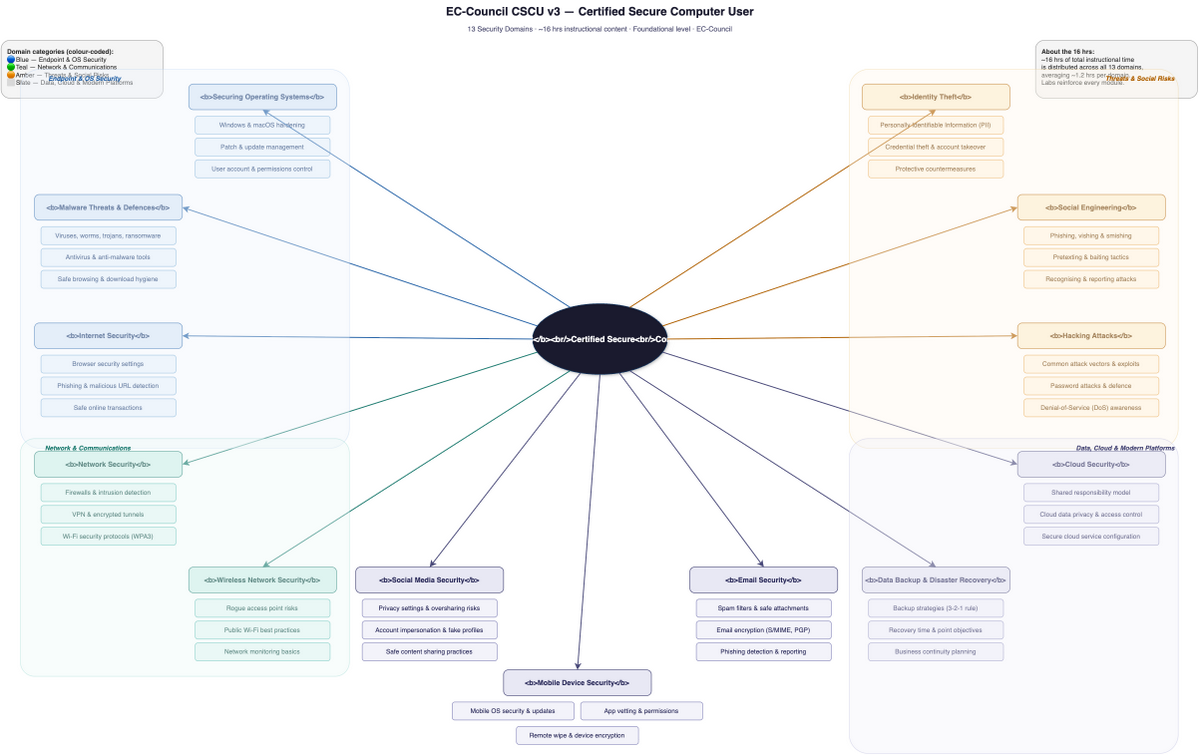
The 13 Domains, Walked Through
EC-Council doesn't publish per-domain weight percentages for CSCU. What follows draws from the official v3 exam blueprint and available community prep materials, all community observations should be understood as limited-source reports rather than confirmed averages.
Domain 1, Foundations of Security (unweighted)
This is the orientation module. What is information security, who are the threats, and what's the triangle between security, functionality, and ease of use? Limited community data suggests questions here focus on recognizing threat types and basic security awareness principles, definitions, categories, checklists. No technical implementation required.
Start here. It sets the vocabulary for every domain that follows.
Domain 2, Securing Operating Systems (unweighted)
The exam focuses on Windows and Mac OS X only. Linux does not appear. Community prep materials suggest questions target practical hardening steps: enabling OS-level encryption (FileVault on Mac), configuring firewalls, enforcing screen-saver passwords, recognizing indicators of system compromise.
What to know:
- Windows hardening checklist items
- Mac OS X: FileVault encryption, network preferences, OS firewall settings
- How malware behaves at the OS layer
Domain 3, Protecting Systems Using Antiviruses (unweighted)
Straightforward. Some candidates report this is one of the easiest modules on the exam, awareness-level knowledge about how antivirus works, how to choose a solution, signature-based versus heuristic detection. The questions aren't asking you to configure an AV tool; they're asking whether you know what the different detection methods are and when each applies.
Know the difference between signature-based and heuristic detection. That distinction shows up.
Domain 4, Data Encryption (unweighted)
Here's where non-technical candidates tend to lose points. Limited community data suggests this is one of the harder domains on the exam, not because the concepts are deeply technical, but because the distinctions between symmetric encryption, asymmetric encryption, and hashing are subtle and scenario questions exploit that confusion.
A short taxonomy to memorize:
- Symmetric encryption: same key encrypts and decrypts (fast, good for bulk data)
- Asymmetric encryption: public key encrypts, private key decrypts (RSA falls here; used for secure key exchange and digital signatures)
- Hashing: one-way transformation, produces a fixed-length digest, used for integrity verification, not for encryption in the traditional sense
- Digital certificates: bind a public key to an identity, issued by a Certificate Authority
- Digital signatures: use asymmetric cryptography to verify the sender's identity and confirm the message wasn't altered
Know what SSL/TLS does and how to recognize the padlock indicator in a browser. That's tested at an applied level, "which of these websites is safe to submit payment to", not a theoretical one.
Domain 5, Data Backup and Disaster Recovery (unweighted)
Logical, practical, and reportedly one of the more approachable domains. Questions present scenarios, your company was hit by ransomware, a hard drive failed, a file was accidentally deleted, and ask what the correct response or backup strategy is.
| Backup Type | What it captures | Recovery time |
|---|---|---|
| Full | Everything | Slowest to back up, fastest to restore |
| Incremental | Changes since last backup (any type) | Fast to back up, slower to restore |
| Differential | Changes since last full backup | Middle ground on both |
Know which backup type fits which scenario. That's the domain in a sentence.
Domain 6, Internet Security (unweighted)
Phishing recognition is the core of this module. Community experience suggests scenario questions describe a website, email, or online interaction and ask you to identify what makes it unsafe, or what the correct user action is. Browser security settings across major browsers (Chrome, Firefox, Safari, IE) are in scope; know which settings to enable for safer browsing.
Child online protection and gaming security are secondary topics. Don't spend primary study time there, but don't ignore them either.
Domain 7, Securing Network Connections (unweighted)
Home and small office wireless security. The exam isn't testing enterprise network architecture, it's testing whether you can recognize a rogue access point, understand why open Wi-Fi is dangerous, and know how to configure a home router securely.
Limited community data points to this as one of the higher-priority modules. Threat recognition is the focus: eavesdropping, rogue APs, improper file sharing configurations.
Domain 8, Securing Online Transactions (unweighted)
Companion to Domain 6, but specifically about money. How do you verify a website is using SSL correctly? What does a fraudulent payment page look like? What types of credit card fraud exist and how do they work?
Some candidates report this domain catches them with its specificity around SSL/TLS mechanics, not "what is SSL" but "which of these URL indicators confirms the connection is encrypted." Know the padlock, know HTTPS, know what extended validation certificates indicate.
Domain 9, Securing Email Communications (unweighted)
Phishing, spam, malicious attachments, and the defensive tools against them. Digital signatures in email get attention here too, understanding what a digital signature does (verifies sender identity, confirms message integrity) rather than how to implement one.
The pattern across available practice materials shows consistent emphasis on identifying phishing email characteristics: mismatched sender addresses, urgency language, suspicious links, unexpected attachments. Know the red flags cold.
Domain 10, Social Engineering and Identity Theft (unweighted)
Scenario-based and reportedly one of the more challenging domains for candidates who studied through recall rather than application. A question won't ask "what is pretexting?", it'll describe a phone call from someone claiming to be IT support asking for your password, and ask what attack technique is being used and what you should do.
Techniques to recognize:
- Pretexting (fabricated scenario to extract information)
- Phishing and spear-phishing
- Tailgating (physical access by following someone through a secure door)
- Baiting (leaving infected USB drives in public spaces)
Know the victim response steps for identity theft too: what to do first, who to contact, what to document.
Domain 11, Security on Social Networking Sites (unweighted)
Lighter than it sounds. The exam focuses on privacy configuration on major platforms and recognizing oversharing risks. (Older v2 materials sometimes include MySpace references, ignore anything like that; it's not v3 content.) Most modern internet users find this module intuitive, which makes it a good domain to lock down early and spend minimal extra time on.
Domain 12, Information Security and Legal Compliance (unweighted)
Three regulations. That's the domain. Know them precisely.
- HIPAA: Health Insurance Portability and Accountability Act, healthcare data protection
- FERPA: Family Educational Rights and Privacy Act, student education records
- PCI DSS: Payment Card Industry Data Security Standard, payment card data
The failure pattern here is candidates who treat this module as minor and skim it. Questions test application: given a scenario involving a healthcare breach, which regulation was violated? Know which law covers which sector. That's genuinely the whole module.
Domain 13, Securing Mobile Devices (unweighted)
Added emphasis in v3. Covers iOS and Android security settings, safe app installation, Bluetooth threat recognition, physical device protection, and what to do if a device is lost or stolen.
Some community prep materials note that mobile device management (MDM) concepts appear, slightly beyond pure personal-user scenarios, but tested at an awareness level rather than a technical administration level.
Where Candidates Lose Points
The failure reports are consistent on this point: the CSCU catches people who studied the wrong way, not people who studied the wrong content.
Memorizing without understanding scenarios. The exam tests application. Knowing that RSA is asymmetric encryption won't save you if you don't know when asymmetric encryption is the right tool and what it protects against.
Skipping the official courseware. The exam blueprint maps directly to the official EC-Council modules. Candidates who bypass the courseware and go straight to dumps, beyond the revocation risk, often find they lack the context to reason through scenario questions. Dumps give you answers; they don't give you the reasoning.
Under-preparing for legal compliance. HIPAA, FERPA, PCI DSS. Three acronyms, three sectors. Every exam has questions that test whether you know which is which. Candidates who treat this as an afterthought routinely drop points they didn't need to.
Not practicing under timed conditions. Two hours for 50 questions feels generous in theory. In practice, scenario questions require careful reading and candidates who haven't simulated exam conditions sometimes feel the clock in the final stretch.
Not testing their proctoring setup. The CSCU is exclusively online-proctored. Corporate networks frequently block the EC-Council exam portal. A failed connection mid-exam is a lost attempt. Test your setup, webcam, microphone, internet speed, non-corporate network, at least 24 hours before your scheduled time.
What Not to Study
This is worth being explicit about, because the CSCU name sometimes confuses candidates about the level of content required.
Skip deep penetration testing concepts. Skip advanced networking beyond home/small office setup. Skip Linux security, the exam covers Windows and Mac OS X only. Skip CLI commands and vendor-specific syntax; questions are conceptual, not command-line. Skip brain dumps entirely: EC-Council actively rotates its question bank, dump content is frequently outdated for v3, and using dumps violates EC-Council exam policy with certification revocation as the consequence.
How to Prepare
Start with the official courseware. The EC-Council iClass CSCU course (16 hours of content) is built from the same blueprint the exam questions derive from. This is the closest alignment you'll find between study material and exam content. The iClass on-demand course costs $159 and includes six months of lab access; the bundle from the EC-Council Store ($149) packages the digital courseware with the exam voucher and lab access, which is the better value if you haven't purchased your voucher yet.
The courseware's one real limitation: it's easier than the exam. Completing the 16-hour course and feeling confident doesn't mean you're ready to sit the test. It means you've covered the content. The next step is testing whether you can apply it.
Use practice questions to find your gaps. CertCompanion has realistic practice questions with detailed explanations for the CSCU; start with 30 free questions at certcompanion.com to get a baseline. Aim for 80–90% on practice sets before you schedule, not 70%. Given the per-form cut score variability, a 72% practice score doesn't give you the margin you need.
Official tools to use alongside:
- CSCU Exam Blueprint v3 (available from cert.eccouncil.org): the definitive domain and sub-objective list; use it as a checklist
- EC-Council Remote Proctoring User Guide: read this before exam day, not on it, covers system requirements, identity verification, and room scan procedures
- EC-Council CE Fee Policy: understand the $20 annual maintenance requirement now, not when renewal comes up
On pricing: EC-Council Academia partner programs can bring the exam voucher cost to as low as $55 for students and academic staff. If you're enrolled in an academic institution, check whether your school has an EC-Council Academia partnership before paying full price.
Study Hours by Background
All estimates below come from limited community sources and should be treated as rough guidance, not guarantees.
| Background | Estimated hours | What drives the range |
|---|---|---|
| Complete non-technical beginner | 24–40 hours | Full course completion plus multiple practice rounds; legal and encryption modules need extra time |
| Office worker or general computer user | 16–24 hours | Work through the official course systematically; supplement with practice tests on weaker domains |
| IT professional with existing security awareness | 8–16 hours | Primarily review and targeted practice; encryption concepts and legal compliance still warrant focused attention |
The official course is two days (16 hours) of content. Most candidates need some time beyond that for practice and reinforcement, particularly on encryption and legal compliance.
Exam Day
Schedule at least three working days in advance through the EC-Council Exam Portal, last-minute scheduling isn't available. During peak periods, some candidates report waiting 60 or more minutes after their scheduled start time before connecting to a live proctor. Build that buffer into your day.
Don't use a corporate network. Corporate firewalls routinely block the exam portal. Use a personal or home internet connection.
The exam opens with a 360-degree webcam room scan. Clear your desk: no papers, no phones, no unauthorized devices. Have a government-issued photo ID ready for identity verification.
Two hours for 50 questions works out to roughly 2.4 minutes per question. Pace at about 2 minutes each, flag questions you're uncertain about, and use the remaining time for review. The scenario questions are longer to read; budget for that.
Scores post immediately after you complete the exam. Badge access through the EC-Council Aspen portal follows within a few days of passing.
One more thing about that voucher: it's valid for one year from the date of receipt, not from when you sit the exam. Some candidates purchase a bundle, set it aside, and discover months later that the clock started the day they bought it.
After You Pass
The CSCU positions you at the entry point of EC-Council's certification pathway. It demonstrates security awareness competency, useful for roles that handle sensitive data without requiring deep technical skills.
Entry-level roles where CSCU is a primary credential typically fall in the $40,000–$65,000 range based on market data. Broader cybersecurity roles associated with the credential extend toward $61,000–$117,000, depending on the technical depth of the position and the candidate's overall background.
Roles that list CSCU as relevant or preferred include IT Support Specialist, Security Awareness Trainer, Help Desk Technician, Entry-Level Compliance Officer, and Remote Work Security Coordinator. The DoD 8570 and VA approvals make it particularly relevant for government and federal contracting environments.
Logical next certifications:
- EC-Council ECSS (Certified Security Specialist): the direct next step in EC-Council's pathway; broadens information security knowledge beyond end-user awareness
- EC-Council C|CT (Certified Cybersecurity Technician): hands-on, lab-heavy entry-level cert for candidates moving toward technical security roles
- CompTIA Security+ (SY0-701): the broader industry standard; broader employer recognition than CSCU and required for many government IT roles
- EC-Council CEH (Certified Ethical Hacker): for candidates who want to move toward offensive security after building a solid foundation
- ISC2 Certified in Cybersecurity (CC): free entry-level cert; a reasonable complement or alternative for foundational security awareness
The $20 annual CE fee keeps your CSCU active between renewals. Missing a year triggers revocation. Set a calendar reminder.
FAQ
How hard is the CSCU exam?
Most candidates who complete the official EC-Council courseware pass on the first attempt, that's the community perception, though EC-Council doesn't publish official pass rate data. The difficulty is less about technical depth and more about the scenario-based question format. If you've studied through recall alone, you'll find the exam harder than expected. If you've practiced applying concepts to situations, it's manageable for a foundational cert.
How many hours should I study?
It depends on your background. Limited community data suggests IT professionals with existing security awareness need roughly 8–16 hours of review and practice. Office workers and general computer users typically report 16–24 hours. Complete non-technical beginners should plan for 24–40 hours, including full courseware completion and multiple practice rounds. These figures come from limited sources; treat them as orientation, not guarantees.
Does the CSCU certification expire?
Yes, it does, despite some older blog posts claiming otherwise. The official EC-Council policy is a three-year validity period with a $20 annual continuing education fee required to maintain the certification. Failure to pay the annual fee results in revocation. If you see a source claiming CSCU doesn't expire, it's inaccurate.
Do I need any prerequisites?
No formal prerequisites. The CSCU is designed for non-technical users and requires no prior IT or cybersecurity certification. Some basic computer literacy is assumed, but you don't need networking or programming knowledge.
What's the retake policy if I fail?
No waiting period after the first failed attempt. Between the second, third, and fourth retakes, a 14-day wait applies. A maximum of five attempts are allowed within any 12-month period. Retake vouchers cost $99 USD through the EC-Council Store.
Is the CSCU worth it for my career?
It depends on your goal. For non-technical employees who handle sensitive data, it's a credible foundational credential. For government and federal contracting roles, the DoD 8570 and VA approvals give it specific value. As a standalone credential for technical security roles, it's a starting point, not a differentiator. Most candidates use it as a foundation for stronger credentials like CompTIA Security+ or EC-Council's own C|CT.
Can I take the exam at a test center?
No. The CSCU is exclusively online-proctored through the EC-Council Exam Portal. Pearson VUE and PSI test centers do not offer this exam. If you've taken other certs at a test center and aren't familiar with remote proctoring, read the EC-Council Remote Proctoring User Guide before your exam day.
What's the difference between the exam voucher and the course bundle?
The standalone exam voucher ($149) covers only the right to sit the exam. The iClass course bundle ($159) adds 16 hours of on-demand video content and six months of lab access, but requires purchasing the exam voucher separately. The EC-Council Store bundle ($149 at time of research) combines digital courseware, lab access, and the exam voucher in a single purchase, generally the best value if you haven't bought anything yet. Verify current pricing directly at cert.eccouncil.org before purchasing.
Closing
The CSCU is a legitimate entry-point certification, not a vanity credential. It tests whether a non-technical person can recognize threats, respond appropriately, and handle sensitive data with the awareness that the job requires. Thirteen domains, 50 questions, two hours. The candidates who struggle aren't the ones who didn't study, they're the ones who memorized facts without ever asking what those facts mean in practice.
Complete the official courseware. Practice under timed conditions. Aim for 80%+ before you book. Test your proctoring setup the day before. And don't forget the $20 annual fee once you've passed.
Ready to find out where your gaps actually are? Start with 30 free CSCU practice questions at CertCompanion, you'll know within the first set which domains need more attention before you schedule.