The Digital Forensics Essentials exam (112-53) is 75 questions in two hours with a 70% passing score. It spreads its weight across 12 domains, and no domain is worth more than 12%. That shape matters more than any single topic: the exam rewards covering every domain, not mastering one.
Where to Spend Your Study Time
The official exam blueprint publishes the weight of every domain, so you do not have to guess where the points are. Use the weights to order your study, not to skip anything.
Start with the heaviest domain. Windows Forensics (Domain 6) carries 12%, the largest share on the exam. The blueprint lists four sub-domains: volatile and non-volatile information, Windows memory and registry analysis, cache, cookie and history recorded in web browsers, and Windows files and metadata.
Do not under-weight the 10% domains. Understanding Hard Disks and File Systems (Domain 3) and Malware Forensics (Domain 12) are 10% each. Together that is 20% of the exam.
Cover the seven 8% domains evenly. Computer Forensics Fundamentals, Data Acquisition and Duplication, Defeating Anti-forensics Techniques, Linux and Mac Forensics, Network Forensics, Investigating Web Attacks and Investigating Email Crimes are 8% each. Seven domains at 8% is 56% of the exam, so they decide the result.
The two 6% domains deserve attention too. Computer Forensics Investigation Process (Domain 2) and Dark Web Forensics (Domain 10) are 6% each. That is a small slice, but skipping either one is easier to avoid once you know every other domain pulls more weight.
What the Exam Covers
The Digital Forensics Essentials certification is aimed at entry-level information security or cybersecurity careers, and at people who want to start one. The certification recognizes foundational knowledge of forensic concepts together with hands-on experience.
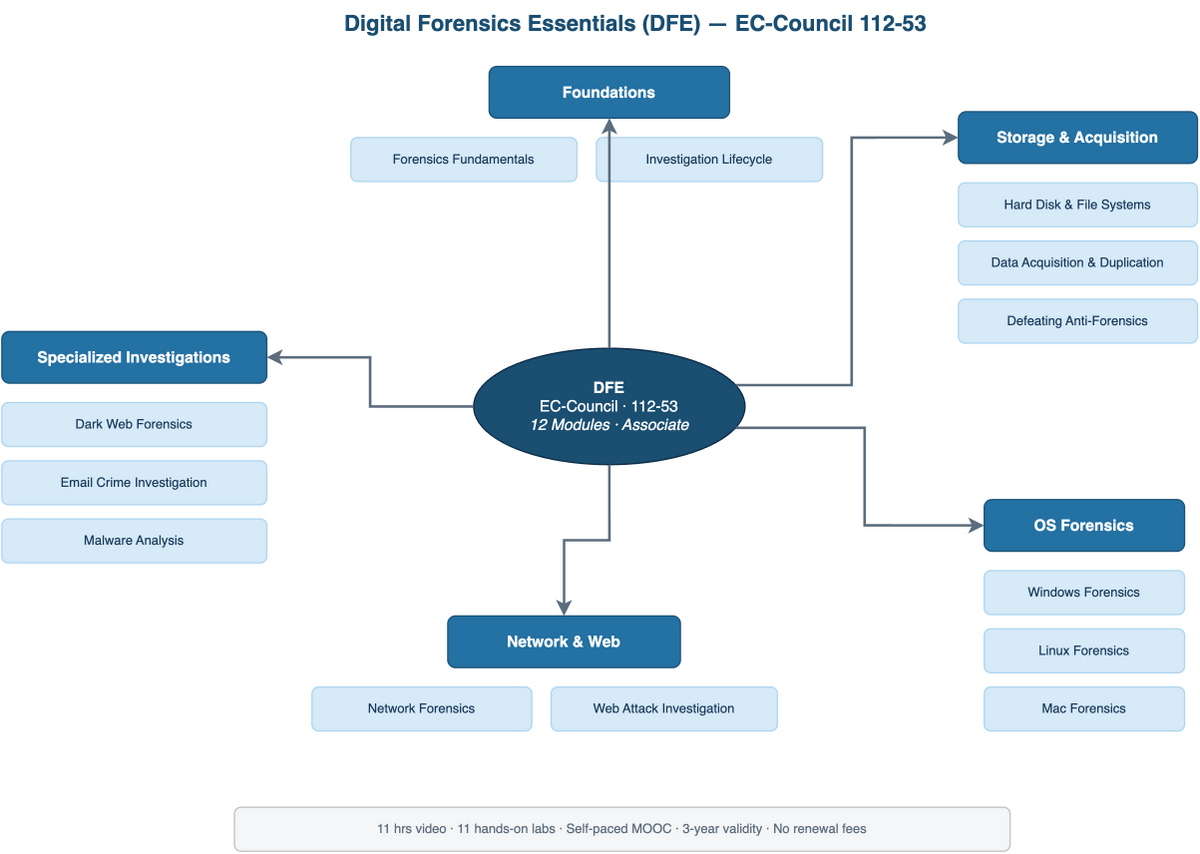
The exam checks the curriculum the blueprint lists: the forensic investigation process, hard disks and file systems, data acquisition, anti-forensics, Windows, Linux and Mac forensics, network forensics, web attacks, dark web forensics, email crimes and malware forensics. The practical way to use that list is as a checklist: if you cannot explain a sub-domain without looking at your notes, you are not ready for it.
Exam at a Glance
| Item | Value |
|---|---|
| Exam code | 112-53 |
| Duration | 2 hours |
| Questions | 75 |
| Passing score | 70% |
| Eligibility | No eligibility criteria |
| Certification validity | 3 years |
| Delivery | ECC Exam Center |
| Blueprint | Exam Blueprint v1 |
| Course bundle price | $299 |
Seventy-five questions in 120 minutes works out to roughly 96 seconds per question. The exam covers 12 domains, so leaving any one of them unstudied puts a real share of the passing score at risk.
There are no eligibility criteria for the DFE program. No IT or cybersecurity experience is required.
Who Should Take This Exam
DFE is positioned as an entry-level, foundational certification. The target audience includes students, graduates, professionals, career starters and career changers, including high school students who want an early start in cybersecurity.
That makes it a fit if you want a structured first step into digital forensics. The credential verifies the knowledge and skills to implement forensic investigations and serves as a foundation for progress to CHFI, the next forensics credential on the path.
If you want a general-purpose cybersecurity certification, the scope here is narrower: forensics methodology, evidence handling and artifact analysis across Windows, Linux, Mac, network, web, email and malware sources.
Domain Breakdown
The weights and sub-domains below are from the official exam blueprint. Treat each sub-domain as a heading you should be able to explain in your own words.
| # | Domain | Weight |
|---|---|---|
| 1 | Computer Forensics Fundamentals | 8% |
| 2 | Computer Forensics Investigation Process | 6% |
| 3 | Understanding Hard Disks and File Systems | 10% |
| 4 | Data Acquisition and Duplication | 8% |
| 5 | Defeating Anti-forensics Techniques | 8% |
| 6 | Windows Forensics | 12% |
| 7 | Linux and Mac Forensics | 8% |
| 8 | Network Forensics | 8% |
| 9 | Investigating Web Attacks | 8% |
| 10 | Dark Web Forensics | 6% |
| 11 | Investigating Email Crimes | 8% |
| 12 | Malware Forensics | 10% |
Domain 1 - Computer Forensics Fundamentals (8%)8%
The blueprint lists five sub-domains: fundamentals of computer forensics, digital evidence, forensic readiness, the roles and responsibilities of a forensic investigator, and legal compliance in computer forensics. This is the vocabulary domain. Learn what counts as digital evidence, what forensic readiness means for an organization, and what an investigator is and is not responsible for, because later domains assume you already use these terms.
Domain 2 - Computer Forensics Investigation Process (6%)6%
The sub-domains are the forensic investigation process and its importance, followed by the pre-investigation, investigation and post-investigation phases. The weight is among the lowest, so a clear picture of the phases and what belongs in each is enough. Being able to place an activity in the right phase is the useful skill.
Domain 3 - Understanding Hard Disks and File Systems (10%)10%
The blueprint covers different types of disk drives and their characteristics, the logical structure of a disk, the booting process of Windows, Linux and Mac operating systems, the file systems of those operating systems, and file system examination. With 10% of the exam, this domain is worth a proper study block. Build a comparison for each operating system: how it boots and which file system it uses.
Domain 4 - Data Acquisition and Duplication (8%)8%
Sub-domains: data acquisition fundamentals, types of data acquisition, data acquisition formats and data acquisition methodology. Know the difference between the types of acquisition, the formats evidence can be stored in, and the order of steps in the methodology. This domain connects to everything else, because every later analysis depends on a trustworthy copy of the evidence.
Domain 5 - Defeating Anti-forensics Techniques (8%)8%
The blueprint has two sub-domains: anti-forensics and its techniques, and anti-forensics countermeasures. Pair every technique with its countermeasure as you study. A two-column table of what an attacker does and how an investigator responds is the most efficient way to learn this domain.
Domain 6 - Windows Forensics (12%)12%
The heaviest domain. The sub-domains are volatile and non-volatile information, Windows memory and registry analysis, cache, cookie and history recorded in web browsers, and Windows files and metadata. Even if you work with Windows every day, this is a forensic view of it: what an investigator can recover, where, and what it tells them. Give it the largest block of your study time and your lab time.
Domain 7 - Linux and Mac Forensics (8%)8%
Sub-domains: volatile and non-volatile data in Linux, analyzing file system images using The Sleuth Kit, memory forensics, and Mac forensics. If your background is mostly Windows, plan extra time for this domain, since The Sleuth Kit and the Linux and Mac sub-domains are the parts most likely to be new.
Domain 8 - Network Forensics (8%)8%
Sub-domains: network forensics fundamentals, event correlation concepts and types, identifying indicators of compromise (IoCs) from network logs, and investigating network traffic. The official course also introduces TCPdump, Wireshark and DNS monitoring among the tools covered, so use them in a lab rather than only reading about them.
Domain 9 - Investigating Web Attacks (8%)8%
Sub-domains: web application forensics, IIS and Apache web server logs, investigating web attacks on Windows-based servers, and detecting and investigating attacks on web applications. The skill to practice is reading a server log and recognizing what happened in it.
Domain 10 - Dark Web Forensics (6%)6%
Two sub-domains: the dark web, and Tor browser forensics. It is one of the two smallest domains, so keep it proportionate: understand what the dark web is and what an investigator can examine on a system where the Tor Browser was used.
Domain 11 - Investigating Email Crimes (8%)8%
Sub-domains: email basics, and email crime investigation and its steps. Learn how an email travels, what a message contains, and the sequence of steps for investigating an email-based crime.
Domain 12 - Malware Forensics (10%)10%
The longest sub-domain list on the blueprint: malware, its components and distribution methods; malware forensics fundamentals and recognizing types of malware analysis; static malware analysis; analyzing suspicious Word documents; dynamic malware analysis; system behavior analysis; and network behavior analysis. At 10% it deserves a study block close to the size of Domain 3.
Reasoning Through a DFE Question
The questions below show the level of detail the exam asks for. The worked example is drawn from our practice bank and shows how an explanation should read: the correct answer, why each wrong option fails, and the concept behind it.
A Scenario Worth Studying
A digital forensics team responds to a ransomware incident where encrypted volumes are currently mounted on a running Windows server. The server contains critical business data and active database connections. According to forensic best practices, what should the team do first? (Select one!)
- A. Immediately pull the power plug to prevent further encryption
- B. Perform live data acquisition of memory and volatile data before powering down
- C. Take a forensic image of the hard drive while the system is running
- D. Document the scene with photographs then power off normally
Show the answer and the reasoning
Correct answer: B. Perform live data acquisition of memory and volatile data before powering down
When encrypted volumes are mounted, encryption keys exist in volatile memory and will be lost upon power-off, making encrypted data unrecoverable. Live acquisition captures memory contents including encryption keys, running processes, and network connections. Pulling the power plug destroys this critical volatile evidence. Imaging the hard drive while running is secondary to capturing memory. Normal shutdown triggers shutdown scripts that may destroy evidence and still loses volatile data.
When you review a question you got wrong, do not stop at the right answer. Write down which blueprint sub-domain it belongs to, because wrong answers cluster by sub-domain, and the cluster tells you what to restudy.
Practice Questions: What Our Bank Looks Like
| DFE question bank | |
|---|---|
| Questions | 626 |
| Single-answer | 531 |
| Select-all-that-apply | 95 (15%) |
| Median explanation length | 90 words |
Practice questions work best after you have finished a domain, not before. Do a short set for each domain, mark the sub-domains you missed, and return to them before moving on. Aim to score well above the 70% pass mark on the full bank before you schedule the exam, so a bad day does not decide the result.
The Preparation Path
Foundation: The Official Course
The official course bundle is priced at $299. The official course includes:
- a CTF-style capstone project with real-world CTF challenges
- 916+ pages of ecourseware
- lab activities in a simulated lab environment
- 1-year access to the ecourseware and 6-month access to the labs
- a proctored exam voucher with 1-year validity
The course covers 12 modules, and the blueprint lists 12 domains. Plan your pace so you reach the exam voucher's one-year limit with room to spare, and use the lab window deliberately: six months of lab access is long enough, but only if you start the labs early.
Use the Blueprint as Your Checklist
Download the DFE Exam Blueprint v1 from the official certification site and treat every sub-domain as a line item. Mark each one "can explain", "need to review" or "have not studied". Your goal is to leave nothing in the last two categories before exam day.
Practice Questions
CertCompanion has practice questions for the DFE with explanations. Start with the free questions at CertCompanion once you finish your first domains, rather than saving them for the end. Gaps found early are cheaper to fix.
For more EC-Council exam resources and to see where DFE fits in the wider EC-Council certification path, the EC-Council exam hub has the full picture.
Retake Policy
- no waiting period before the first retake
- a 14-day wait before each of the second, third and fourth retakes
- no more than five attempts in a 12-month period, after which a 12-month wait applies before another attempt
- a candidate who passes cannot attempt the same version of the exam again
Candidates who do not pass can buy an ECC Exam Center voucher to retake at a discounted price. Official guidance also strongly advises anyone who fails a third time to attend official hands-on training that covers the certification objectives.
Study Order
A reasonable sequence follows the weights and how the topics build on each other:
- Foundations first: Domains 1, 2 and 4 (fundamentals, investigation process, acquisition). They give you the vocabulary and the evidence-handling rules every other domain uses.
- Storage and operating systems: Domains 3, 6 and 7 (file systems, Windows, Linux and Mac). These are the heaviest cluster, 30% of the exam together.
- Attacks and network: Domains 8, 9 and 11 (network, web, email). Practice reading logs and headers in the labs.
- Specialist topics: Domains 5, 10 and 12 (anti-forensics, dark web, malware).
- Full-bank practice: a timed run through mixed questions, then targeted review of whichever sub-domains you missed.
A recommended number of study hours is not published for DFE, so plan by the checklist rather than by a clock. When every sub-domain is in the "can explain" column and your practice scores are comfortably above the pass mark, you are ready to book.
On Exam Day
The exam is delivered through the ECC Exam Center. Read the official exam policies before the day, because they set the rules that govern how an attempt is handled, and the certification body reserves the right to revoke certification status for candidates who do not comply with them.
At roughly 96 seconds per question, pace yourself. If a question stalls you, mark it, move on and come back after you finish the rest. Do not let one hard question cost you the time for several easy ones.
After You Pass
The DFE certification is valid for three years from the date of the successful exam attempt. No continuing education fees or Continuing Education credits are required to maintain the credential during the three-year term. After the three years, members may recertify by passing the DFE exam again.
DFE builds the skills needed to progress to CHFI, the Computer Hacking Forensic Investigator certification. If you want a forensics career, treat DFE as the first step and CHFI as the next one on the path.
My Honest Assessment
A $299 bundle that includes the course, labs, a capstone and the exam voucher is a reasonable structured start if you are new to forensics and want everything in one place. The labs are the part to take seriously: they turn the blueprint's sub-domains from a list of terms into skills you can use.
The credential's limits are worth knowing. It is an entry-level certification from a single vendor, and it is positioned as a foundation for CHFI rather than an endpoint. If you already work in digital forensics, it will not stretch you; if you are starting out, it gives you a defined syllabus to follow, which is its main value.
Frequently Asked Questions
How many questions are on the DFE exam? 75 questions, in a 2-hour exam, with a 70% passing score, per official exam documentation.
How should I split my study time across domains? Follow the blueprint weights. Windows Forensics is the largest at 12%, Understanding Hard Disks and File Systems and Malware Forensics are 10% each, seven domains are 8% each, and Computer Forensics Investigation Process and Dark Web Forensics are 6% each.
How many hours should I study for the DFE? A recommended study time is not published for DFE. Use the blueprint sub-domain checklist instead: you are ready when you can explain every sub-domain and your practice scores sit comfortably above 70%.
Does the DFE certification expire? Yes. It is valid for three years from the date you pass. No continuing education fees or Continuing Education credits are required during that term, and members can recertify by passing the DFE exam again.
Are there prerequisites for the DFE? No. There are no eligibility criteria for the DFE program. No IT or cybersecurity experience is required.
Can I retake the exam if I fail? Yes. There is no waiting period before the first retake and a 14-day wait before each of the second, third and fourth retakes. You cannot take the exam more than five times in a 12-month period.
What does the $299 course include? The course bundle includes: a CTF-style capstone, 916+ pages of ecourseware, lab activities, 1-year ecourseware access, 6-month lab access, and a proctored exam voucher valid for one year.
What comes after the DFE? DFE is described as building the skills needed to progress to CHFI, the Computer Hacking Forensic Investigator certification.
The DFE rewards even coverage of 12 domains. Order your study by the blueprint weights, verify each domain with practice questions, and start with the free questions at CertCompanion.
Checked against official EC-Council DFE exam documentation. Last verified 2026-11-01.