The PMI-PBA is a 200-question, 240-minute exam, and its five domains are not equal slices: Domain 3 alone is 35% of the items. A study plan that ignores that distribution is working against the blueprint the exam is built on. This guide sticks to what PMI itself publishes: the format, the domain weights and tasks, the fees, the eligibility sets, and the renewal rule.
TL;DR
- 200 questions in 240 minutes, offered in English and Simplified Chinese, at a Pearson VUE test center (PMI's recommended option) or securely online
- Five domains with fixed weights: Analysis 35%, Planning 22%, Needs Assessment 18%, Traceability and Monitoring 15%, Evaluation 10%
- Exam fee on PMI's page: $405 for PMI members, $555 for everyone else, due only after PMI accepts your application
- You can attempt the exam up to three times in one year if you do not pass
- Three eligibility sets, each with 35 contact hours of business analysis education and experience earned in the last 8 years
- Renewal: 60 professional development units (PDUs) in each three-year cycle
Exam at a Glance
| Item | Value (as listed on PMI's PMI-PBA page) |
|---|---|
| Exam length | 200 questions |
| Exam time | 240 minutes (4 hours) |
| Languages | English, Chinese (Simplified) |
| Exam fee | $405 (PMI member) / $555 (full price) |
| Attempts | Up to three in one year if you do not pass |
| Testing | Pearson VUE test center (recommended) or securely online |
| Maintenance | 60 PDUs in each three-year cycle |
PMI's content outline describes the test as a multiple-choice format examination. The domain percentages determine how many items come from each domain and task. If another site gives you an exact cut score or an exact number of unscored items, ask where the figure comes from.
The arithmetic that matters is time. Two hundred questions in 240 minutes is 72 seconds per question on average. That is a planning figure, not a rule: some items will take less, and a long scenario will take more. What the average tells you is that a question that eats four or five minutes has to be paid for somewhere else.
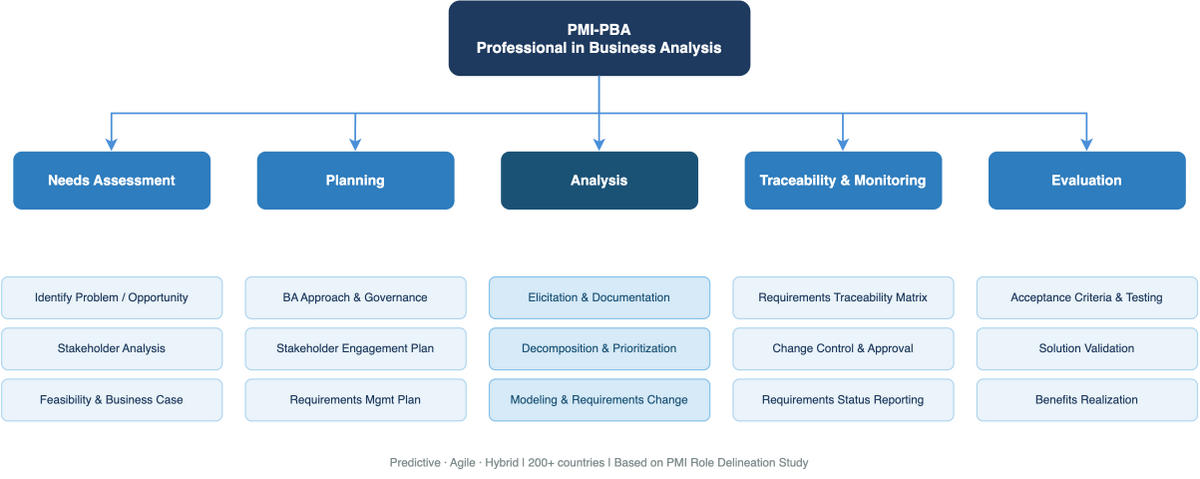
The Five Domains and Exactly How Much Each One Weighs
PMI's Examination Content Outline (ECO) assigns the following percentages of items on the test:
| Domain | Weight |
|---|---|
| Domain 1: Needs Assessment | 18% |
| Domain 2: Planning | 22% |
| Domain 3: Analysis | 35% |
| Domain 4: Traceability and Monitoring | 15% |
| Domain 5: Evaluation | 10% |
Look at that distribution before you build a study schedule. Domain 3 is three and a half times the weight of Domain 5. If you split your time evenly, you spend about 20% of your prep on a domain worth 10% of the items, and about 20% on a domain worth 35%. Weight your hours the way the exam weights its items, and keep checking the live outline on the official website, because PMI can revise it.
On 200 questions, the percentages translate roughly into the following item counts. These are arithmetic from the published weights, not a number PMI prints: about 36 items for Needs Assessment, 44 for Planning, 70 for Analysis, 30 for Traceability and Monitoring, and 20 for Evaluation.
Domain 1: Needs Assessment (18%)18%
PMI describes this domain as activities related to understanding a business problem or opportunity and evaluating various inputs to help develop an effective solution. The tasks in the outline, in plain language:
- Define or review a business problem or opportunity, using problem and opportunity analysis techniques, to develop a solution scope statement or provide input to a business case
- Collect and analyze information from a variety of sources, using valuation tools and techniques, to contribute to the value proposition of the initiative
- Collaborate on project goals and objectives by clarifying business needs and solution scope, so the product aligns with the organization's goals
- Identify stakeholders by reviewing goals, objectives, and requirements, so the appropriate parties are represented, informed, and involved
- Determine stakeholder values regarding the product, using elicitation techniques, to give you a baseline for prioritizing requirements
The pattern behind these tasks is order of work. The outline starts with the problem and the value proposition, then moves to goals, stakeholders, and what stakeholders value. When a practice question offers a solution before the problem has been defined, that ordering is the thing to check.
Domain 2: Planning (22%)22%
Planning focuses on the preparation required to manage the business analysis activities that will occur within the project. PMI says this includes establishing tools, policies, and procedures for the requirements management plan, requirements traceability, change management, document control, and acceptance criteria.
At 22%, Planning is the second-largest domain, and it's the one candidates with strong hands-on analysis experience tend to treat as paperwork. The outline treats it as its own body of work. Expect the plans and procedures themselves to be fair game: the requirements management plan, the traceability approach, the change control process, document control, and acceptance criteria.
Domain 3: Analysis (35%)35%
PMI describes Analysis as centered on requirements management activities: the elicitation, analysis, decomposition, acceptance, approval, specification, and validation of requirements. The outline lists eight tasks:
- Elicit or identify requirements, using individual and group elicitation techniques, to discover and capture requirements with supporting details such as origin and rationale
- Analyze, decompose, and elaborate requirements, using techniques such as dependency analysis, interface analysis, and data and process modeling
- Evaluate product options and capabilities, using decision-making and valuation techniques, to determine which requirements are accepted, deferred, or rejected
- Allocate accepted or deferred requirements by balancing scope, schedule, budget, and resource constraints with the value proposition, to create a requirements baseline
- Obtain sign-off on the requirements baseline, using decision-making techniques, to achieve stakeholder consensus and approval
- Write requirements specifications using process details (such as use cases and user stories), data, and interface details, so requirements are measurable and actionable
- Validate requirements using techniques such as documentation review, prototypes, and demos, to confirm they are complete, accurate, and aligned with goals
- Elaborate and specify detailed metrics and acceptance criteria, for use in evaluating whether the solution meets requirements
This is the domain to master. Eight tasks over 35% of the items means the exam covers the whole life of a requirement. The outline separates writing a specification (task 6) from validating it (task 7) and from defining acceptance criteria (task 8). A question that asks what comes next in that chain is testing whether you know the sequence.
Domain 4: Traceability and Monitoring (15%)15%
This domain covers managing the life cycle of requirements: continuous monitoring and documenting of requirements, and communicating requirements status to stakeholders. The outline lists five tasks:
- Track requirements using a traceability artifact or tool, capturing status, sources, and relationships including dependencies, to provide evidence that requirements are delivered as stated
- Monitor requirements throughout their lifecycles, to ensure the supporting artifacts (such as models, documentation, and test cases) are produced, reviewed, and approved at each point
- Update a requirement's status as it moves through its lifecycle states, by communicating with stakeholders and recording changes in the traceability artifact or tool
- Communicate requirements status to the project manager and other stakeholders, to keep them informed of issues, conflicts, changes, risks, and overall status
- Manage changes to requirements by assessing impacts, dependencies, and risks in accordance with the change control plan, and comparing to the requirements baseline
The last task is the one to remember: change management here means assessing impact against the baseline and following the change control plan. It's a natural source of sequencing questions, because the impact assessment comes before a change is escalated or approved.
Domain 5: Evaluation (10%)10%
Evaluation covers the assessment of how well the delivered solution fulfills the requirements and meets the business need. The first task listed is to validate the solution's test results, reports, and other test evidence against the requirements' acceptance criteria, to determine whether the solution satisfies the requirements. The outline also mentions determining if there are gaps and obtaining sign-off.
It is the smallest domain, but it closes the loop on everything above it. Acceptance criteria written in Domain 3 and planned in Domain 2 are what the evidence gets measured against here.
What the Exam Costs
PMI's page shows two prices for the PMI-PBA:
| PMI Member | Full price | |
|---|---|---|
| Exam fee | $405 | $555 |
The $150 difference is the gap between the two fees on PMI's page. PMI says the exam fee is only required after your application has been accepted and you are ready to schedule. Check PMI's current fee policy for retakes before you plan around a second attempt. Prices change, so confirm them on the official website before you pay.
PMI's page also says you may attempt the exam up to three times in one year if you do not pass. Treat that as a ceiling, not a plan: each attempt has to be scheduled and paid for, and a failed attempt tells you nothing you could not have learned from timed practice beforehand.
Eligibility: What Experience and Education PMI Requires
PMI lists three sets of requirements. You need to meet one of them before you apply.
| Set A | Set B | Set C | |
|---|---|---|---|
| Education | Secondary degree (high school diploma, associate's degree, or global equivalent) | Bachelor's degree or higher (or global equivalent) | Bachelor's or postgraduate degree from a GAC accredited program (or global equivalent) |
| Experience | 60 months as a business analysis practitioner, earned in the last 8 years | 36 months as a business analysis practitioner, earned in the last 8 years | Minimum two years (24 months) of unique, nonoverlapping professional business analysis experience |
| Education hours | 35 contact hours in business analysis practices | 35 contact hours in business analysis practices | 35 contact hours of formal education |
Two practical points follow from this table. First, the 35 contact hours are a hard requirement for every set, so a course that documents contact hours does double duty as eligibility and preparation. Second, the experience windows are counted from the last 8 years, so old experience does not carry forward indefinitely.
From Application to Exam Day
PMI describes a short sequence:
- Check eligibility against the sets above
- Complete the application. Document the projects you have led, where you worked, your role and responsibilities, the duration of projects, and the training you completed. PMI's advice is to describe your role and responsibilities on the project, not the project itself. You can save the application as you go.
- Pay and schedule once your application is accepted. PMI verifies identity with a selfie and a government-issued photo ID, such as a driver's license, military ID, passport, or national identification card, and the ID must have English characters or a translation, your photo, and your signature.
- Study for the exam
- Take the exam, at a Pearson VUE test center or securely online
If you are selected for an eligibility audit, PMI says to confirm your eligibility by providing a copy of your degree, verification of experience signed by a supervisor, and proof of project management experience. PMI describes the audit as part of the process, so keep your documents ready before you submit.
Pacing 200 Questions Across 240 Minutes
Because the published figures are 200 questions and 240 minutes, you can build a pacing plan from arithmetic alone. At 72 seconds per question on average, checkpoints at roughly question 50 (about 60 minutes), question 100 (about 120 minutes), and question 150 (about 180 minutes) keep you on pace. These checkpoints are our suggestion, not PMI guidance.
Practical habits that follow from the format:
- Read the whole scenario before the options. In an exam built from tasks like "obtain sign-off on the requirements baseline" and "manage changes to requirements by assessing impacts," a single detail in the scenario often decides which step comes first.
- Flag a question only when you have read it twice and cannot reason to an answer. Flag too many and you will have no time left to return to them.
- Do not guess which items are unscored. PMI's pages say nothing about unscored items, so treat every question as one that counts.
- Guard the clock in the first half. Time lost early is hard to recover late.
For the testing environment itself, follow the instructions PMI and Pearson VUE send after you schedule. Requirements for online delivery differ from a test center, and those instructions are the authority.
Where Business Analysis Knowledge From Other Frameworks Helps
The outline notes that the questions are written and reviewed by qualified business analysis professionals and are supported by current published business analysis references. PMI also says candidates should be well advised to read the current edition of the PMBOK Guide as one of their references, plus other current titles on business analysis.
That matters if you studied business analysis under a different framework. The underlying analytical skills carry over: elicitation, stakeholder analysis, requirements management, traceability. The vocabulary and the order of activities are what you must verify. When a concept looks familiar from another body of knowledge, find how PMI's outline states the task and use that wording, because the exam is written against the ECO, not against any other guide.
Keeping the Credential: 60 PDUs Every Three Years
PMI says PMI-PBA holders need to earn 60 professional development units (PDUs) in each three-year cycle to maintain the certification. Each PDU represents one hour spent on activities such as learning, teaching others, presenting, reading, volunteering, and content creating. PMI also has a dedicated page on maintaining and renewing certifications, and that page is the place to confirm any category minimums before you plan your cycle.
Start tracking PDUs in the first year rather than the third. An hour of reading or teaching counts, so the work you do to prepare for the exam and to support colleagues afterwards can feed the requirement, subject to PMI's own rules.
Study Resources and Practice
PMI's own page points candidates to its PMI-PBA exam prep resources, and PMI's outline lists the PMBOK Guide and other current business analysis titles as references. Use the official outline as your checklist: read each task, and for every task ask whether you could explain the technique, the input, and the step that follows it.
Practice questions are most useful when you tie each miss to a domain and a task. CertCompanion's PMI-PBA practice questions come with explanations, so you can see why the correct sequence beats the tempting one. Start with the free questions at CertCompanion to see where you stand before committing to a study schedule.
| PMI-PBA question bank | |
|---|---|
| Questions | 846 |
| Single-answer | 792 |
| Select-all-that-apply | 54 (6%) |
| Median explanation length | 93 words |
Avoid brain dump sites. Memorized answers do not help on an exam built from scenario tasks, and a wrong explanation can plant a wrong mental model that costs you several questions. Stay with materials tied to PMI's outline.
You can browse all PMI certification practice exams at CertCompanion.
A Real PMI-PBA Question, Worked Through
The PMI-PBA rewards a specific kind of reasoning: knowing when an activity happens and what it depends on, not just what each activity is. The question below tests exactly that skill, using the traceability and change management tasks from Domain 4.
A business analyst manages changes to requirements for an enterprise system implementation. A stakeholder submits a change request to add multi-factor authentication. Before presenting to the Change Control Board, what should the business analyst do FIRST? (Select one!)
- A. Schedule a workshop to gather detailed requirements for the authentication feature
- B. Update the Requirements Traceability Matrix with the new requirement
- C. Communicate the change request to all stakeholders for awareness
- D. Conduct impact analysis to assess effects on schedule, cost, and related requirements
Show the answer and the reasoning
Correct answer: D. Conduct impact analysis to assess effects on schedule, cost, and related requirements
The change control process requires impact analysis as the first step after receiving a change request. Impact analysis assesses effects on cost, schedule, scope, quality, risks, and dependencies before the CCB can make an informed decision. Updating the RTM occurs after approval, not before. Communication happens after impact analysis and decision. Gathering detailed requirements is premature until the change is approved. PMI-PBA emphasizes assessing impact before any other change management activities.
The mistake this question exposes is common: candidates who know what a change control board does choose an answer that sends the request to it immediately, skipping the analysis that comes first. The outline's wording is explicit that managing changes means assessing impacts, dependencies, and risks in accordance with the change control plan, and comparing to the requirements baseline. Knowing the sequence, not just the names of the activities, is what the exam measures.
Frequently Asked Questions
How many questions are on the PMI-PBA and how long is the exam?
PMI's PMI-PBA page lists 200 questions and 240 minutes. The exam is offered in English and Chinese (Simplified).
What does the PMI-PBA cost?
PMI's page lists $405 for PMI members and $555 at full price. PMI says the exam fee is only required after your application has been accepted and you are ready to schedule your exam. Confirm the current amount on the official website before you pay.
How many times can I take the PMI-PBA?
PMI says you may attempt the exam up to three times in one year if you do not pass. Check PMI's current policy for retake fees before budgeting for a second attempt.
What are the domain weights?
Needs Assessment 18%, Planning 22%, Analysis 35%, Traceability and Monitoring 15%, and Evaluation 10%. These are the percentages of items on the test in PMI's Examination Content Outline.
Can I take the PMI-PBA online?
PMI's page says you can take the exam at a Pearson VUE testing center, which PMI recommends, or securely online.
What are the eligibility requirements?
PMI lists three sets. Set A: a secondary degree, 60 months as a business analysis practitioner earned in the last 8 years, and 35 contact hours in business analysis practices. Set B: a bachelor's degree or higher, 36 months of that experience in the last 8 years, and the same 35 contact hours. Set C: a bachelor's or postgraduate degree from a GAC accredited program, at least 24 months of unique, nonoverlapping professional business analysis experience, and 35 contact hours of formal education.
How do I keep the PMI-PBA?
PMI-PBA holders earn 60 PDUs in each three-year cycle. Check PMI's maintenance page for the current rules before you plan your cycle.
What happens if I am audited?
PMI says an eligibility audit is part of the process. You confirm your eligibility by providing a copy of your degree, verification of experience signed by a supervisor, and proof of project management experience.
The PMI-PBA is built on a published blueprint, and the blueprint is the best study plan you will find. Domain 3's 35% weight means you cannot pass on effort spread evenly across five domains. Read the outline task by task, weight your hours toward Analysis and Planning, and use scenario-based practice from the start of your prep, not as a final check. Run timed sets under real conditions so you know your pace before the clock is real.
Start with CertCompanion's PMI-PBA practice questions to see where you stand before you commit to a study schedule, then build your prep plan around what the results show: CertCompanion.
Checked against official PMI PMI-PBA exam documentation and current candidate reports. Last verified 2026-11-01.