The PL-900 doesn't test whether you can define Power Apps. It tests whether you can look at a business problem and say "that's a Power Automate cloud flow, not a desktop flow" and explain why. The word "Fundamentals" fools people into thinking it's a vocabulary quiz. It's a judgment quiz wearing a vocabulary quiz's clothing, and the questions are written to punish anyone who studied definitions instead of decisions.
I sat with a colleague who'd failed this exam once. Smart person, ran a SharePoint team, knew Microsoft 365 cold. She told me she'd "read the whole learning path" and walked in confident. What sank her wasn't a hard concept. It was a scenario question describing a workflow that touched a legacy desktop application with no API, and she picked "cloud flow" because that's the one she'd used at work. The exam wanted desktop flow. She knew both terms. She just hadn't practiced choosing between them under a clock.
That's the whole exam in one story.
TL;DR before you commit
- The exam is scenario-heavy. Case studies ask when and why to use a tool, not what it is. Definitions alone won't carry you.
- Power Apps is the biggest domain at 28%. The canvas vs model-driven distinction shows up repeatedly, and candidates conflate the two constantly.
- Study time ranges 15–40 hours depending on background. Complete beginners land near the top of that range.
- Power BI is gone. It was removed as a standalone domain in the June 2025 refresh. Old study materials still over-weight it. Don't fall for that.
- Governance and admin concepts get neglected. They're worth 18% and they show up more than people expect.
- The passing score is 700/1000, the credential is lifetime (Fundamentals certs don't expire), and it costs $99 USD.
- Hands-on beats watching. A few hours in the free Power Platform Developer Plan internalizes more than twice the video time.
What this exam is really about
Think of the Power Platform as four ways to solve a business problem without writing much code: build an app, automate a process, publish an external site, and store the data underneath it all. The PL-900 is testing whether you understand which layer solves which problem. It's a governance-and-fit exam more than a technical one.
The mental model that unlocks it: every question is really asking "given this business situation, what's the Microsoft-recommended tool, and why not the others?" Power Apps for internal apps. Power Automate for workflows. Power Pages for external-facing sites. Dataverse holding the structured data. Once you can route a scenario to the right tool automatically, most of the exam falls into place. The candidates who struggle are the ones who memorized what each tool is without ever forming an opinion about when to reach for it.
Exam at a glance
| Item | Value |
|---|---|
| Cost | $99 USD (varies by country) |
| Duration | 45 minutes |
| Questions | 40–60 (multiple choice, drag-and-drop, matching) |
| Passing Score | 700/1000 |
| Format | Multiple choice, drag-and-drop, matching, scenario-based |
| Validity | Does not expire (Fundamentals credentials are lifetime) |
| Testing | Online proctored or test center |
| Retake Policy | 24 hours after first fail; 14 days after subsequent fails (max 5 attempts per 12 months) |
| Current Version | Skills updated June 20, 2025 |
Do the arithmetic on the time budget. Forty-five minutes across up to 60 questions gives you 45 to 65 seconds each. That's tight for a Fundamentals exam, and it's tighter than people expect because the scenario questions take longer to read than a straight definition question. If you dawdle on the first ten, you'll rush the last ten.
The question style is where the difficulty actually lives. You get multiple-choice items with answer options that sound almost identical, drag-and-drop matching exercises, and short case studies. The nuance is deliberate. Two answers will both be technically true Power Platform facts, but only one fits the scenario as described. Reading comprehension carries real weight here.
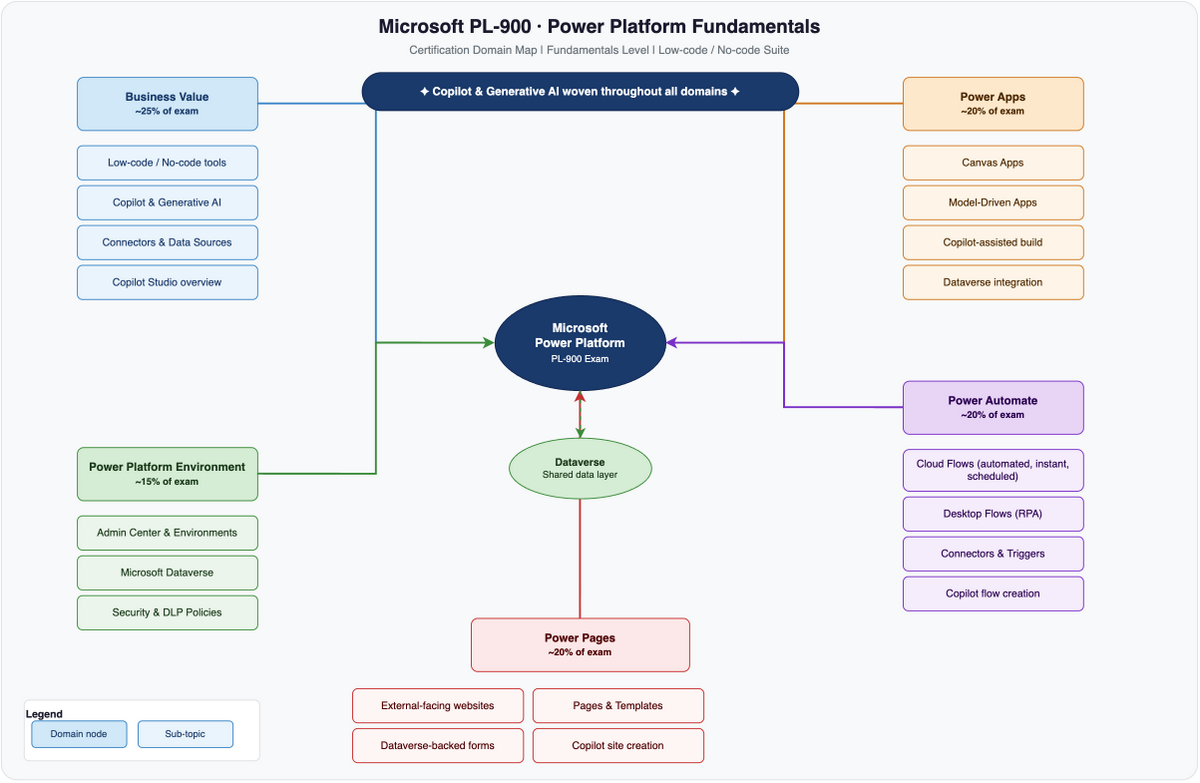
One version note that matters more than any single fact: Power BI was removed as a standalone domain in the June 2025 update. If your study material spends a chapter on Power BI reports and dashboards, it's out of date. The current five domains are Business Value, Manage Environment, Power Apps, Power Automate, and Power Pages.
Who should take this exam, and who should skip it
The PL-900 fits business analysts, Microsoft 365 admins, SharePoint teams, helpdesk staff moving toward low-code work, and anyone whose organization is spinning up a citizen-developer program. If your company runs Dynamics 365 or is standardizing on Power Platform, this is a sensible entry point and a credential that stays on your record forever.
Here's the honest limit: outside the Power Platform ecosystem, this cert does very little for you. It's not a general cloud credential and it won't move the needle on a pure infrastructure or security resume. If you have no plans to touch Power Apps, Power Automate, or Dataverse, and you're picking a Fundamentals cert to look busy, pick a different one. The value of PL-900 is almost entirely as the front door to the PL-200 / PL-300 / PL-400 / PL-600 path.
The domains, layer by layer
The five domains map to conceptual layers rather than a checklist of features. Business Value is the "why," Manage Environment is the "where it lives," and the three capability domains are the "how." Here's each one, treated a little differently, because they don't all deserve the same handling.
Domain 1, Business Value of Microsoft Power Platform (18%)18%
This domain wants you to explain the platform to a decision-maker. Use cases for Power Apps, Power Automate, and Power Pages. The value of connectors for stitching services and data together. What Dataverse is and why it matters. A Copilot Studio overview and where Power FX formulas fit. How the whole thing sits inside Microsoft 365 and Dynamics 365.
The pattern across pass reports shows the tested content here is scenario framing, not memorization. Expect questions that describe a business goal and ask which component delivers it. Understanding the business value of connectors and Dataverse comes up often. Don't treat this domain as soft, it sets the reasoning style for everything else.
Domain 2, Manage Power Platform Environment (18%)18%
Picture this. You've built a slick canvas app in a shared environment, and someone asks who can see the customer data behind it and whether a data loss prevention policy blocks the connector to an external service. If you can't answer that, you've found the domain most candidates neglect.
This is the governance layer: Dataverse tables, columns, and relationships; the security model; admin centers and portals; environments and solutions; data privacy and accessibility. What shows up repeatedly in community threads is that governance policies and AI Builder governance are frequently tested yet routinely under-studied. Dataverse architecture is a must-know, not a nice-to-have. People skim this domain because it's less fun than building apps. That's exactly why it costs them points.
Domain 3, Power Apps Capabilities (28%)28%
The big one. More than a quarter of the exam, and the single most-tested area. If you budget your study time evenly across domains, rebalance toward this one.
The distinction that generates the most questions is canvas apps versus model-driven apps, and limited community data suggests it appears in roughly three to five questions. Many candidates conflate the two, so here's the split worth memorizing cold:
- Canvas apps: drag-and-drop UI, pixel-level control over layout, connect to almost any data source. You design the screen.
- Model-driven apps: data-first, built on Dataverse only, interface auto-generated from your data model. You design the data, the app follows.
Beyond that split, know data source connectors, responsive design with containers, Copilot controls, and forms, views, and app sharing. The one detail people miss under pressure: model-driven apps require Dataverse. Canvas apps don't. That single constraint answers a surprising number of scenario questions.
Domain 4, Power Automate Capabilities (18%)18%
The core decision here is cloud flow versus desktop flow, and it's the exact trap that caught my colleague. Cloud flows run through APIs and connectors. Desktop flows are RPA: they automate legacy applications by driving the user interface when no API exists.
Within cloud flows, know the three trigger types, instant, automated, and scheduled, and be able to match a scenario to the right one. Understand triggers and actions, loops and branching logic, and testing and monitoring. Then there's Process Mining for analyzing existing processes. Multiple experience threads say the same thing: the questions test whether you can pick the right flow type from the scenario, so anchor on the API-versus-UI-automation difference and let the rest follow.
Domain 5, Power Pages Capabilities (13%)13%
The smallest domain, and the cleanest distinction on the whole exam. Power Pages is for external users. Power Apps is for internal employees. That one line answers most of what this domain asks.
Beyond it: external website creation, the design studio workspace, components, themes, and publishing, and security concepts for external users. The June 2025 update expanded this domain with hands-on site creation using Copilot. It's a small slice of the exam, but the external-versus-internal differentiation is high-value because it's easy to test and easy to get wrong when you're moving fast.
Domains ranked by candidate difficulty
Community reports are limited here, so treat this ordering as directional rather than gospel. Based on what candidates report struggling with:
- Power Apps (28%), hardest, mostly because of the canvas vs model-driven confusion and its sheer weight on the exam.
- Manage Environment (18%), hard because it's neglected, not because it's conceptually deep. Governance and AI Builder governance catch people off guard.
- Power Automate (18%), the cloud vs desktop flow decision trips speed-readers who pattern-match to what they've used at work.
- Business Value (18%), moderate. The scenario framing raises the floor above pure memorization.
- Power Pages (13%), the most approachable, thanks to the clean external-vs-internal split.
The real difficulty of the PL-900 isn't any one hard topic. It's breadth. You have to hold all five layers in your head and route scenarios correctly across them. That's the primary challenge, not technical depth.
Where candidates lose points
The failure reports are consistent on a handful of patterns. Most are self-inflicted.
- Underestimating it because it says "Fundamentals." People walk in casual and get surprised by scenario complexity. This is the number-one cause of a failed first attempt.
- Studying definitions instead of decisions. Brain dumps and rote memorization collapse the moment a question asks when and why rather than what. They also violate Microsoft's Terms of Service, so they're a bad bet twice over.
- Using outdated materials. Anything pre-June 2025 over-weights Power BI, and often Copilot Studio and AI Builder, in ways the current exam doesn't. Match your study guide to the current five-domain outline.
- Skipping hands-on practice. The free Power Platform Developer Plan is underused. Reading about a canvas app is not the same as building one.
- Not practicing under time pressure. If your only practice was untimed, the 45-to-65-seconds-per-question reality will rattle you.
One thing I'd personally skip: any deep dive into Power BI dashboard building. It's out of the current exam, and the hours are better spent on governance, which is in the exam and which almost everyone shortchanges. It's not nothing to reallocate that time.
A study sequence that holds up
The order matters more than the resource. Build the foundation, then get your hands dirty, then drill scenarios under a clock.
Foundation. Start with the official Microsoft Learn PL-900 learning path, roughly 18 hours of free, self-paced content that maps closely to the exam objectives and includes sandbox labs. This is the spine of your prep. Its one weakness: it's aligned to objectives but lighter on the nuanced, similar-sounding scenario questions the real exam throws at you. Finishing it means you know the material. It doesn't mean you're calibrated to the question style.
Official study guide. Keep the official PL-900 study guide open as your domain checklist. It reflects the June 20, 2025 skills update. Tick off every listed skill before you schedule.
Hands-on. Spin up the Power Platform Developer Plan. It's free and non-expiring. The most upvoted advice over the last year is blunt about this: a few hours building actual artifacts, a canvas app, a model-driven app, a cloud flow, internalizes far more than the equivalent time watching videos. Build the thing. Then build the other kind of the thing so the canvas-versus-model-driven distinction stops being abstract.
Practice questions. This is where you convert knowledge into exam readiness. Drill scenario-based questions on CertCompanion's PL-900 practice set until you're scoring 80% or better, consistently, under time pressure. The gaps you find in week two are cheaper to fix than the ones you find on exam day. Active recall through practice questions is roughly two to three times more efficient than passive rewatching.
Official exam tools worth using:
- Microsoft Learn PL-900 learning path (~18 hours, free, includes labs)
- Power Platform Developer Plan (free, non-expiring sandbox)
- Official Microsoft free practice assessment (50 questions, per-skill scoring)
- Official skills-measured PDF, straight from Microsoft
The official free practice assessment deserves special mention. Fifty questions with per-skill scoring tells you exactly which domain is dragging you down. Use it to target your last week of study, not to feel good about yourself.
Study hours by background
The spread here is wide, and it's honest. Your starting point drives almost everything.
| Background | Estimated hours | Notes |
|---|---|---|
| Experienced Power Platform user (Power BI dev, Power Apps/Automate user) | 8–15 hours | You already reason in these tools. You're filling gaps and calibrating to the question style. |
| Intermediate (M365/SharePoint admin, business analyst with M365 experience, general IT/helpdesk) | 15–25 hours | You know the ecosystem but not the specific tools. Governance and the app distinctions are your work. |
| Complete Microsoft beginner | 30–40 hours | You're learning the platform and the exam at once. Hands-on time is non-negotiable at this level. |
What drives the difference is prior exposure to the actual tools, not general IT smarts. A sharp helpdesk tech with no Power Platform experience often needs more hours than a Power Automate user who's built flows at work. Familiarity with the decision-making, not raw technical ability, is what shortens the timeline.
On exam day
The 45-minute clock is the whole game. A pacing structure that community reports back: spend roughly 30 minutes on your first pass through every question, 10 minutes on the ones you flagged, and 5 minutes on a final review. If you're spending more than about a minute on any single question during the first pass, flag it and move on.
Read every question stem twice. Watch for NOT, EXCEPT, and ONLY. These keywords invert the answer and they're placed to catch speed-readers. The second read is where you catch them.
When you're unsure, work by elimination. Rule out answers that reference the wrong product entirely. Reject deprecated or old feature names. When two answers both look plausible, favor the Microsoft-recommended approach, the exam rewards the "right way," not the clever workaround. Keyword-spotting in the stem helps too: the word "automate" points you toward Power Automate, "external site" toward Power Pages.
Scores post at the end of the session. Fundamentals credentials don't expire, so once you pass, that badge is yours for good. No renewal, no continuing education, no annual fee.
Career impact, honestly
The PL-900 is a doorway, not a destination. On its own it signals foundational literacy and qualifies you as a citizen developer or entry-level business analyst on Power Platform teams. Its real value is as the first step on a specialist track that pays well.
Community reports and salary databases for 2026 suggest the roles this path leads to range from Power BI Data Analyst at roughly $75K–$115K, to Power Platform Functional Consultant at $80K–$130K, Power Platform Developer at $90K–$140K, and Solution Architect at $110K–$160K. According to ZipRecruiter, Microsoft Power Platform Fundamentals jobs list in the $50–$88 per hour range. Demand for Power Platform skills has trended up as organizations lean into low-code and citizen-developer programs, though this specific credential carries limited weight outside that ecosystem.
The logical next certifications depend on where you're headed:
- PL-200 (Functional Consultant) if you're on the configuration and business-solution track. This is the most common next step.
- PL-300 (Power BI Data Analyst) if data and reporting are your direction.
- PL-400 (Developer) if you're writing custom code and extensions.
- PL-600 (Solution Architect) further down the road, once you have real design experience.
Recent candidate threads
Real posts from people preparing for or recently sitting the PL-900. Read these for the unfiltered version of what the exam felt like:
- Microsoft NEW AI Business Solutions Credentials, r/AzureCertification · 9 comments
- GOT MY Pl900, r/AzureCertification · 11 comments
- Certification Path FOR Power Platform, r/AzureCertification · 5 comments
Threads pulled from the Reddit communities most active for Microsoft certifications.
FAQ
Is the PL-900 hard? Not conceptually, but it's harder than the "Fundamentals" label implies. The difficulty comes from scenario questions that ask when and why to use a tool, plus similar-sounding answer options and a tight 45-minute clock. Most people who fail underestimated it and studied definitions instead of decisions. Prepare for judgment questions, not vocabulary, and it's very passable.
How many hours should I study for PL-900? Between 15 and 40 hours depending on background. Experienced Power Platform users often need only 8–15 hours, intermediate M365 admins and analysts land around 15–25, and complete beginners should budget 30–40. Prior hands-on exposure to the actual tools matters far more than general IT experience in setting your number.
Does the PL-900 certification expire? No. Microsoft Fundamentals certifications are lifetime credentials with no renewal requirement, no continuing education, and no annual fee. Once you pass, the badge stays on your transcript permanently. That's a genuine perk compared to role-based Microsoft certs, which require annual renewal.
Are there prerequisites for PL-900? None. It's an entry-level exam designed for candidates new to the Power Platform. That said, some familiarity with Microsoft 365 and basic business-process concepts makes it noticeably easier. Complete beginners can still pass, they just need more hours and, above all, hands-on time in the free sandbox.
Is PL-900 worth it for my career? It depends on your direction. Inside the Power Platform ecosystem it's a solid entry point to a well-paid specialist path leading to PL-200, PL-300, PL-400, and PL-600 roles. Outside that ecosystem its value is limited, it's not a general cloud or security credential. Only pursue it if low-code work is part of your plan.
What's the retake policy if I fail? You can retake after 24 hours following your first failure. After a second or later failure, you wait 14 days between attempts. Microsoft caps you at five attempts within any 12-month window. Most candidates who fail once pass on the second try after focusing on the scenario style and their weakest domain.
What should I not study for the current PL-900? Skip Power BI as a major standalone topic, it was removed in the June 2025 refresh. Older materials still over-emphasize it, along with Copilot Studio and AI Builder as primary domains. Match your prep to the current five-domain outline. And avoid brain dumps entirely, they violate Microsoft's Terms of Service and don't prepare you for scenario questions.
What's the passing score for PL-900? 700 out of 1000. Microsoft scaling means it isn't a flat 70% of raw questions, the scale accounts for question difficulty. Some candidates report scores in the 750–900 range, though score-distribution data is limited and varies. Aim for 80% or better on practice assessments before you schedule, and you'll have comfortable margin.
The bottom line
The PL-900 is passable for almost anyone willing to prepare correctly, and unpassable for anyone who mistakes "Fundamentals" for "easy." The material isn't deep. The breadth is the challenge, five conceptual layers you have to route scenarios across, plus a question style that punishes memorization and rewards judgment. Build things in the free sandbox, drill scenario questions under a clock, don't neglect governance, and ignore anything that still treats Power BI as a headline domain. Do that, and 15 to 40 hours later you'll walk out with a credential that never expires and a clear path forward.
Ready to find out where your gaps are? Start with CertCompanion's PL-900 practice questions and drill scenarios until 80% is your floor, not your ceiling.