Domain 3 is the heaviest part of the AB-410 exam at 40–45%, and it is where the newest skills sit: building prompts in AI Hub, adding knowledge to a prompt, customizing prompt settings and models, and consuming prompts and AI models in apps and cloud flows. Spread your study evenly across the three domains and you under-prepare for the part that counts most.
TL;DR
- Passing score is 700/1000 (official). No partial credit; no curve.
- Domain 3 (Build Business Application Logic and Automation) carries 40–45% of the exam on its own.
- The official skills list puts AI Hub work in Domain 3: build prompts, add knowledge, customize prompt settings and models, and consume prompts and AI models in apps and cloud flows. Practice each one hands-on.
- Canvas app skills in Domain 2 include named formulas, user-defined functions, variables and collections, error handling and testing with Monitor.
- Use the official study guide as your checklist and the Power Fx reference documentation for formula syntax.
- Retakes: 24 hours after a first failed attempt, at most 5 attempts in 12 months. Renewal is free.
Where Can I Find Realistic AB-410 Practice Questions?
Start with CertCompanion's AB-410 practice questions at /exams/microsoft-certified-intelligent-applications-builder-associate-ab-410. The bank has detailed explanations, and you can start with 30 free questions to get a feel for the difficulty before committing to a full prep session.
| AB-410 question bank | |
|---|---|
| Questions | 600 |
| Single-answer | 446 |
| Select-all-that-apply | 154 (26%) |
| Median explanation length | 140 words |
The official Microsoft AI Skills Navigator practice assessment is a useful reference point for understanding exam format and question style, since it comes from the same source that wrote the exam objectives. Use it to calibrate where you actually stand after building fluency with Power Fx syntax and scenario-based reasoning through volume practice.
What AB-410 Actually Measures: Three Domains and the One That Dominates
AB-410 has three official domains. Two carry roughly equal weight; one dominates.
| Domain | Name | Official Weight |
|---|---|---|
| 1 | Create a Foundation for Intelligent Applications | 25–30% |
| 2 | Create Intelligent Applications | 25–30% |
| 3 | Build Business Application Logic and Automation | 40–45% |
| - | Passing score | 700 / 1000 |
| - | Format | Multiple choice, drag-and-drop, case studies; possible interactive lab components |
| - | Testing | Pearson VUE, online proctored or test center |
| - | Validity | 1 year (free renewal via online assessment) |
| - | Retake policy | 24-hour wait after first fail; max 5 attempts in 12 months |
Domain 3 is nearly half the exam. That single fact should shape every hour you spend preparing. Domains 1 and 2 together account for 50–60% combined; Domain 3 accounts for up to 45% alone. If your prep time is distributed evenly across the three domains, you're systematically under-preparing for the heaviest part.
The format adds a wrinkle. Case studies and possible interactive lab-based components mean you're not just recalling facts, you're applying them in constructed scenarios where the qualifying word in the question determines the right answer. "This app only," "at runtime," "without storing the value": these are the words that differentiate a correct answer from a plausible-looking distractor. Read every question sentence at least twice.
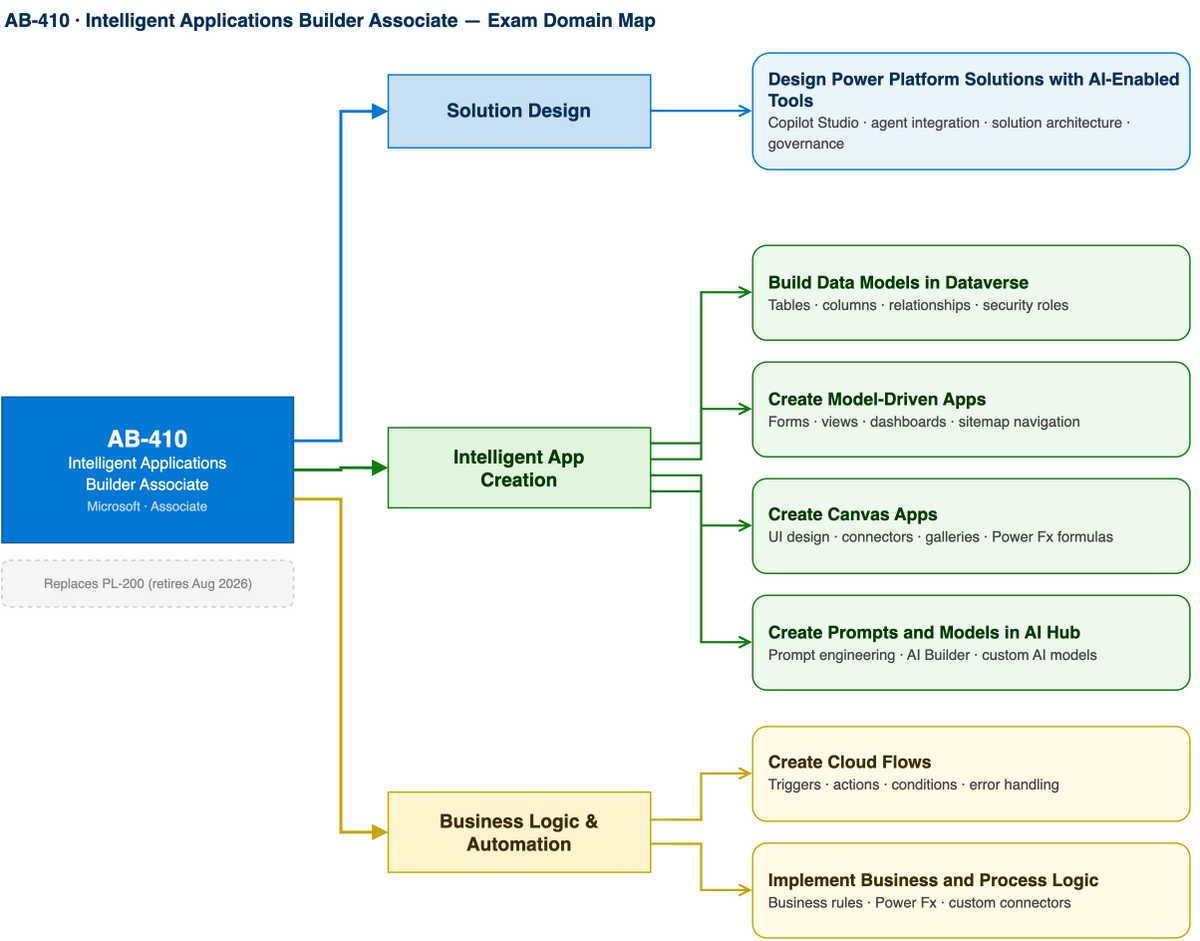
Domain 1, Create a Foundation for Intelligent Applications (25–30%)
This domain covers two intertwined areas: designing Power Platform solutions with AI-enabled tools, and building the Dataverse data models those solutions depend on.
On the solution design side, the exam tests your ability to evaluate built-in agents, recommend extensibility approaches, identify the right environment types, and apply ALM strategies including solution lifecycle management. Responsible AI principles are also in scope, not as a philosophical discussion, but as a concrete design consideration when choosing which capabilities to use.
On the Dataverse side, you're expected to configure tables, columns, and relationships, set up views, forms, and security, and work with the newer prompt columns and row summaries features. Dataverse governance, roles, policies, and environment controls, is also tested.
ALM sits inside this domain: the study guide lists "Apply a Microsoft Power Platform solution and ALM strategy" under designing solutions. Treat solutions, environments and lifecycle management as hands-on topics, because the skill is applying a strategy to a scenario, not naming one.
Domain 2, Create Intelligent Applications (25–30%)
Domain 2 splits into model-driven app creation and canvas app creation.
For model-driven apps: forms, views, generative pages built with natural language, charts, dashboards, and access configuration are all in scope. These are well-documented areas and candidates with Dynamics 365 or Power Apps experience tend to find them manageable.
The canvas app list is the longer one: creating an app from data, designing for accessibility, performance, responsiveness and usability, automating business processes, reusable components (named formulas, user-defined functions, component libraries), variables and collections, error handling, and testing with Monitor.
One additional skill explicitly tested here: creating a Copilot Studio agent from an existing canvas app. This is a hands-on capability, not a conceptual one. You need to have done it, not just read about it.
Domain 3, Build Business Application Logic and Automation (40–45%)
Domain 3 decides whether you pass. It is 40–45% of the exam. Three sub-areas: cloud flows, AI Hub content: Prompt Builder and AI Builder models, and classic business process logic.
Cloud flows cover triggers, connectors, approvals, flow control with conditions and loops, and testing and troubleshooting. These are well-understood by most experienced Power Platform practitioners; the questions are scenario-based with close distractors, but the underlying concepts aren't new.
AI Hub is the part that requires extra work. Building prompts from templates in AI Hub, adding knowledge sources for grounding, configuring inputs and outputs, customizing model settings and understanding their limitations, consuming prompts in both canvas apps and Power Automate flows; each of these is a line in the official skills list. You can't learn this area theoretically. You need a live environment and hands-on time with each capability.
AB-410 is the direct successor to PL-200, which Microsoft retired on August 31, 2026. The business process logic sub-area covers business rules, business process flows, and calculated, rollup and formula columns.
What to Practice Hands-On, Skill by Skill
The official study guide lists skills as verbs: create, configure, consume, evaluate, recommend. Each verb is something you do in a live environment, so use the list as a lab plan rather than a reading list.
Power Fx and canvas apps. Build one canvas app from data, then add a named formula, a user-defined function, a component from a component library, a collection, and an error-handling path. Test it with Monitor so you can see formula evaluation and network calls for yourself. The Power Fx reference documentation is the authority on syntax.
Solutions and ALM. Create a solution, add your tables, app and flow to it, and export it as a managed solution. Look at what changes between a development and a test environment. This is what "apply a solution and ALM strategy" looks like in practice.
AI Hub. Build a prompt from a template and another from blank, add a knowledge source, add an input, change the model in the prompt settings, then consume the prompt from a canvas app and from a cloud flow. Repeat for an AI model.
Think of it like reading a flight manual versus logging simulator hours. The manual tells you what everything does; the simulator is where you learn whether you know how to use it.
Reading Scenario Questions Slowly
Whatever the format, scenario questions hinge on qualifiers. "This app only" versus "across apps," "at runtime" versus "at design time," "without storing the value" versus "with a variable": one qualifier can turn a correct option into a distractor. Read every scenario twice, find the qualifier first, and only then look at the options.
For Power Fx, read formulas the way you would trace code: what is the scope of each variable, in what order does evaluation happen, and does the formula do what the question says it should? The reference documentation sections on variables, collections and named formulas are the right place to practice that.
Check Older Study Material Against the Current Study Guide
AB-410 was available in beta before general availability, so notes and videos from that period may not match what is tested now. The current official skills list is the authority: compare any older material against it and drop topics the guide no longer lists.
How to Structure Your Study So the Gaps Get Covered
Use the official AB-410 study guide as your objective checklist. Go through every skill measured line by line and confirm you can actually do it, not just define it. That's the starting frame.
Background from the retired PL-200 certification helps with Dataverse modeling, canvas apps, model-driven apps and cloud flows. The AI Hub skills are listed explicitly in this exam's outline, so give them separate hands-on time.
Read the Power Fx reference documentation directly. Don't stop at what the AB-410 path shows you. Focus on variables, collections, named formulas, and user-defined functions; build formulas and test their behavior in a real environment so you can recognize what correct and incorrect code looks like.
Get a Power Apps Developer Plan, it's free. Build a complete end-to-end solution: Dataverse tables with relationships, a canvas app, a model-driven app, a cloud flow with approvals, an AI Hub prompt with a knowledge source, security roles, the whole stack. Then export it as a managed solution. That build sequence touches every testable skill in one coherent exercise.
For AI Hub specifically: build prompts from templates, add knowledge sources for grounding, configure model settings, and then consume those prompts from both a canvas app and a Power Automate flow. Do each of those as a hands-on step, not a reading exercise.
The right amount of study time depends heavily on your existing Power Platform experience. Candidates new to the platform need to cover both foundational Power Platform skills and the new AI Hub content; those with PL-200 or active practitioner experience can focus their additional study on the AI-specific gaps. There is no published official figure for study hours, and community data on this exam is still thin given how recently it launched. Let your practice assessment scores, not a target hour count, tell you when you're ready.
Visit /exams/provider/microsoft for a full view of Microsoft certification paths and how AB-410 connects to the broader Power Platform and AI track.
Reasoning Through a Power Platform Test Automation Question
The next question comes from our practice bank. It targets the "test canvas apps" skill from the official outline: choosing the right tool for a constrained validation scenario, not just knowing which tools exist.
Litware Solutions is establishing a formal quality assurance process for their Power Platform intelligent application portfolio. A quality engineer needs to create repeatable, automated test cases that validate canvas app logic, screen navigation, and formula behavior after each managed solution is deployed to the test environment. The team requires a native Power Platform tool that avoids introducing external testing frameworks or third-party dependencies. Which tool should the quality engineer use to author and execute the automated test cases? (Select one!)
- A. Power Apps Monitor
- B. Solution Checker
- C. Power Platform Test Studio
- D. Power Platform Pipelines deployment validation gates
Show the answer and the reasoning
Correct answer: C. Power Platform Test Studio
Power Platform Test Studio is Microsoft's native built-in testing tool for authoring and executing automated test cases against canvas apps and model-driven apps. It allows quality engineers to record and write structured test steps, validate control states, assert formula outcomes, and run test suites repeatedly after each deployment without any external framework. Power Apps Monitor is a real-time diagnostic tool used to trace formula execution, network requests, and connector calls while an app runs, making it useful for investigating individual issues but not for authoring or replaying structured automated test suites. Solution Checker performs automated static analysis of solution components to identify compatibility issues, deprecated API usage, and coding standard violations against documented rules, but does not test runtime application behavior or business logic. Power Platform Pipelines orchestrate the sequential deployment of solutions across development, test, and production environments and support stage-level validation settings, but they do not include a mechanism for running automated functional tests against the deployed application.
Questions like this expose a common mistake: candidates conflate "testing" in a general sense with the specific Power Platform tooling designed for automated regression. Knowing that Monitor exists for debugging isn't the same as knowing which tool creates repeatable, shareable test suites. Practice questions with close distractors are how you build that habit.
Retake Rules and the Free Annual Renewal
These are official facts. Know them before you schedule.
Retake policy:
- Wait 24 hours after a first failed attempt before retaking.
- Maximum 5 attempts of the same exam within 12 months from the date of the first attempt.
- Each retake is a paid attempt.
- You can't retake a passed exam unless the certification has expired.
Renewal:
- The certification is valid for 1 year.
- Renewal is free: take an online assessment on Microsoft Learn within the 6 months before your certification expiry date.
- Passing the renewal assessment extends the certification by one year.
The retake limit has a practical consequence for your study approach. If you attempt AB-410 before you're ready and fail twice, you've used two of your five annual attempts and paid twice. The gap between feeling prepared and being prepared is real. Take the official practice assessment and aim for consistent performance before booking.
Frequently Asked Questions
What's the question format on the AB-410 exam? The official exam format includes multiple choice, drag-and-drop, and case studies. Interactive lab-based components are also possible. Case studies test applied judgment across a scenario, not isolated recall. The format is more demanding than a straightforward multiple-choice bank because the scenario framing adds complexity, and qualifying words in the scenario change the correct answer.
Does AB-410 have a specific exam duration or question count? Neither is officially published on the certification pages. Microsoft shows both when you schedule the exam through Pearson VUE.
What does the exam cost? Exam pricing is country-dependent and displayed when you schedule. Microsoft doesn't publish a fixed price on the certification pages.
Is AB-410 difficult if I already have PL-200? PL-200 background helps with Dataverse modeling, canvas apps, model-driven apps, cloud flows and business logic. The outline for this exam also lists AI Hub skills (prompts, knowledge, prompt settings and models, and consuming prompts and AI models in apps and flows), so plan separate hands-on time for them whatever your background.
What should I study after passing AB-410? The natural next step depends on your direction. For deeper development skills, a code-heavy Power Platform developer path builds on what AB-410 covers. For AI and agent-building skills, deeper work in Copilot Studio extends what you practiced for Domain 3. For enterprise architecture, a senior-level Power Platform solution architect path is the progression for those working at scale. Each takes you further into one of the three core areas AB-410 establishes.
AB-410 puts 40–45% of its weight on one domain, and that domain holds the newest skills: AI Hub prompts and models alongside cloud flows and business logic. Use the official study guide as your checklist, turn each verb in it into something you have built in a live Power Apps Developer Plan environment, and check your readiness with practice questions before you schedule. The exam rewards candidates who built the things, not just read about them.
Start with 30 free practice questions at CertCompanion's AB-410 exam page to identify which areas need the most work before you schedule.
Checked against official Microsoft AB-410 exam documentation. Last verified 2026-10-26.