You have 45 minutes. That's it. No extensions, no revisiting Microsoft Learn mid-exam, no Googling what Parquet is. The DP-900 looks like a gentle entry-level quiz, and for three of its four domains, it is. Then the analytics workload questions arrive, and candidates who scored 90% on the official practice assessment find themselves staring at a 591 fail. This is not a hard exam. But it is an exam that will punish you for skimming the part that matters most.
The Trap Everyone Falls Into First
Before we talk about what to study, let's talk about the mistake that sends people back for a retake.
The official Microsoft Learn practice assessment is free, quick, and feels like good preparation. It is not. Community members report scoring 82–92% on it and still failing the real exam with a 591. The gap isn't because the questions are slightly harder. The gap is because the assessment recycles a limited question pool, so after two or three attempts you're memorizing answers rather than understanding concepts. It feels like readiness. It isn't.
The pattern across failure reports is consistent: candidate uses only the official assessment as their benchmark, feels confident, books the exam, gets destroyed by analytics workload questions worded in a way they've never encountered, fails. Don't be that candidate.
The second failure pattern is cramming. One documented case: no IT or data background, three days of study with an all-nighter, score of 591. Sleep deprivation makes everything worse, and three days is not enough for anyone starting from scratch.
The third pattern is using only one practice resource. The official assessment alone isn't enough. The MS Learn content alone isn't enough. You need multiple angles on the same concepts, because the real exam will rephrase things in ways your single source never did.
And the fourth: ignoring the analytics workload domain because it's at the end of the study guide. It's 25–30% of the exam and the primary failure point. Start there, not at the end.
What This Exam Is Really About
DP-900 is a conceptual exam, not a hands-on one. That's worth saying clearly, because it changes how you should study.
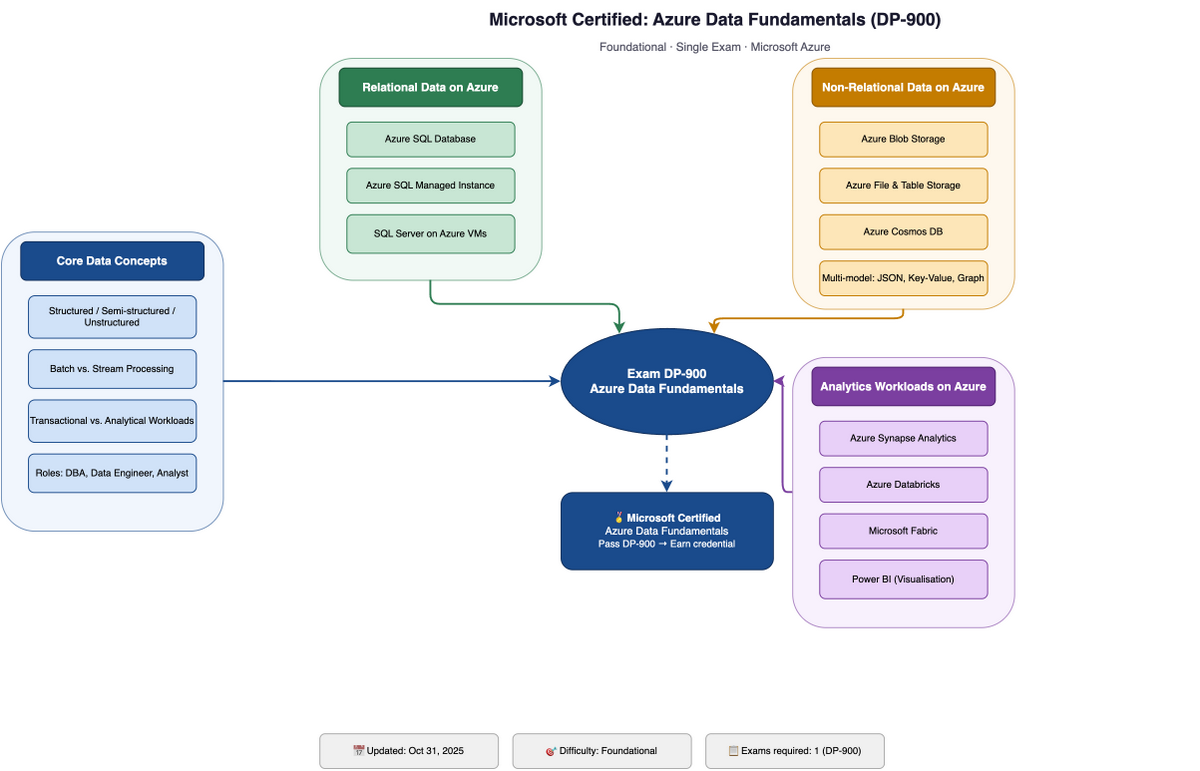
Think of it this way: Microsoft wants to know whether you can have an intelligent conversation about data in Azure with a technical team, not whether you can write a Spark job or optimize a SQL query. The exam is testing your mental map of the data landscape: what kinds of data exist, what Azure services handle each kind, when you'd use a data lake versus a data warehouse, and how analytics flows from raw data to a Power BI dashboard.
Every domain is a conceptual layer. Domain 1 is the foundation, data types and data roles. Domain 2 stacks relational services on top of that. Domain 3 adds non-relational storage. Domain 4 puts analytics and visualization on the top of the stack. The whole thing is a progression, which means if you treat each domain as an isolated checklist, you'll miss the scenario questions that span layers.
Exam at a Glance
| Item | Detail |
|---|---|
| Cost | $99 USD (varies by country/region) |
| Duration | 45 minutes |
| Questions | Variable, Microsoft does not publish a fixed count |
| Passing Score | 700/1000 |
| Format | Multiple choice, multiple response, may include interactive components |
| Validity | Does not expire (foundational certifications do not require renewal) |
| Testing | Online proctored or test center via Pearson VUE; students and educators can use Certiport |
| Retake Policy | 24 hours after first attempt; subsequent retake intervals vary per Microsoft policy |
| Last Updated | July 21, 2026 (minor updates to three subtopics) |
The question format is worth paying attention to. Multiple choice and multiple response are the backbone, but the official Microsoft exam page confirms interactive components may appear. These could be drag-and-drop matching or scenario-based hot-area questions. Use the official exam sandbox before exam day so the interface isn't unfamiliar when it matters.
The July 2026 update made minor wording refinements to three subtopics: "Describe ways to represent data," "Describe capabilities of Azure storage," and "Describe considerations for real-time data analytics." The domain weights did not change. One notable structural shift: Azure Synapse Analytics is no longer explicitly named in the Domain 4 study guide subtopics. Microsoft Fabric and Azure Databricks are now the primary analytics service references for that domain. If your prep materials are from early 2024 or older, verify they reflect this.
Time-Pressure Math
45 minutes. Say the exam has 40 questions, which is a reasonable community estimate, though Microsoft doesn't publish the number. That's 67 seconds per question.
67 seconds.
That's not enough time to work through a confusing analytics scenario from scratch. It's enough time to read it, recognize the concept being tested, and pick the right answer if you already know the material. The time pressure here isn't brutal like a 3-hour professional exam, but it does mean you cannot afford to slow-burn your way through the analytics domain questions that already take more mental effort.
The practical implication: if a question genuinely stumps you, mark it and move on. Coming back to it with 10 seconds left is better than spending 3 minutes on it and losing time you needed elsewhere. Don't skip questions outright, the exam doesn't penalize for wrong answers, so every question should have an answer when you submit.
Who Should Take This Exam
DP-900 is the right move if you're starting a career in data or cloud, want to validate foundational knowledge before tackling associate-level certifications, or need a credential to qualify for Microsoft's free voucher programs like AI Skills Fest.
It's also well-suited for business analysts, BI professionals, or database administrators who work adjacent to Azure data services and want a credential that legitimizes their understanding of the full landscape.
Who should wait: if you're already working with Azure data services daily and planning to go straight to DP-600, DP-700, or PL-300, you might find DP-900 is a speed bump rather than a foundation. Some experienced practitioners have passed it with minimal prep. Others prefer to bank the time on the higher-value cert directly.
For people targeting data careers with no cloud background, this is the right starting point. For people with no IT or data background at all, take a breath, give yourself three to four weeks, and don't cram.
The Four Domains
Domain 1, Describe Core Data Concepts (28%)28%
This domain covers what data is before it touches any Azure service. Structured data has schemas, tables, rows, and columns. Semi-structured data, JSON, XML, key-value pairs, has some structure but doesn't enforce it strictly. Unstructured data is images, video, documents: no predefined schema at all.
File formats matter here. You need to know when to use CSV (simple, human-readable, row-based), JSON (semi-structured, web APIs), Parquet (columnar, efficient for analytics), Avro (row-based, good for streaming), and ORC (columnar, Hive ecosystem). The scenario questions will give you a use case and ask which format fits.
The domain also covers the three core data roles: database administrators manage and maintain database systems; data engineers build pipelines and move data between systems; data analysts query data and create reports. These definitions come up in scenario format, "which role is responsible for this task", and some candidates underestimate how specific the distinctions need to be.
OLTP versus OLAP is the other major concept here. OLTP (transactional) is optimized for fast reads and writes of individual records, maintains ACID properties, and powers operational systems. OLAP (analytical) is optimized for aggregations across large datasets and powers reporting. The exam will present a scenario and ask which workload type fits.
Some candidates report this domain felt straightforward, even in failure scenarios. The concepts are genuinely more accessible than analytics workload, and the scenario questions are less ambiguously worded. Build a solid base here, but don't spend disproportionate time on it.
Domain 2, Identify Considerations for Relational Data on Azure (23%)23%
Relational data concepts come first: tables, primary and foreign keys, constraints, normalization. Normalization is about organizing data to reduce redundancy, the exam tests whether you understand the purpose, not whether you can write third normal form from scratch.
SQL statements appear at recognition level. You need to know what SELECT, INSERT, UPDATE, DELETE, and JOIN do. You don't need to write complex queries or understand query optimization. The exam is testing conceptual literacy, not SQL fluency.
The Azure services in this domain are the Azure SQL family: Azure SQL Database (a fully managed PaaS offering), Azure SQL Managed Instance (a broader compatibility surface, closer to on-premises SQL Server, still managed), and SQL Server on Azure Virtual Machines (IaaS, full control, lift-and-shift). Knowing when to recommend each is where the scenario questions live. Managed Instance is the right answer when an application needs near-complete SQL Server compatibility and you don't want to manage the OS. SQL on VMs is the right answer when you need full OS-level access or specific configurations that managed services don't support. Azure SQL Database is the right answer for new cloud-native applications that don't need legacy compatibility.
Open-source options also appear: Azure Database for PostgreSQL and Azure Database for MySQL. The exam tests awareness, not deep configuration knowledge.
Limited community data suggests questions about Azure SQL subscription and payment models have surprised candidates, not a topic that appears prominently in practice materials. The official study guide mentions it; don't skip it.
Domain 3, Describe Considerations for Working with Non-Relational Data on Azure (18%)18%
This is the lightest domain by weight and the one community members find most manageable. The services break into two groups: Azure Storage (Blob, Files, Table) and Azure Cosmos DB.
For Azure Storage: Blob storage holds unstructured data, documents, images, videos. It has three access tiers. Hot is for data accessed frequently. Cool is for data accessed less often but still relatively regularly. Archive is for data rarely accessed, with retrieval latency measured in hours. The exam gives you a scenario and asks which tier fits. Azure Files provides managed file shares for SMB and NFS protocols. Azure Table Storage is a key-value NoSQL store for structured data that doesn't need a relational schema.
Cosmos DB is the globally distributed NoSQL database. The most important thing to know here is the API mapping. Use the Core (SQL) API when you want to query with a SQL-like syntax. Use the MongoDB API when you're migrating an existing MongoDB workload. Use the Cassandra API for wide-column data. Use the Gremlin API for graph data, relationships between entities, social networks, recommendation engines. Use the Table API for key-value data when you need global distribution and higher throughput than Azure Table Storage provides.
Know those API mappings by scenario. The exam will describe a use case and ask which API fits. Community experience confirms this is a consistent question pattern.
Domain 4, Describe an Analytics Workload on Azure (28%)28%
This is the hard domain. Not hard to understand once you've studied it properly, hard to reason about under exam conditions if your understanding is thin. This is where candidates fail, and it deserves more study time than any other domain.
The core conceptual split is batch versus streaming. Batch processing handles data in chunks at scheduled intervals, think nightly ETL jobs that process a day's transactions. Streaming processes data continuously as it arrives, think real-time fraud detection or live dashboard updates. Know when each is appropriate; the exam will give you a scenario and ask which approach fits.
Analytical data stores need to be clearly differentiated. A data warehouse stores structured, processed data organized for reporting and historical analysis, optimized for read-heavy aggregation queries. A data lake stores raw data in any format, structured or not, at scale, optimized for flexibility and volume. A data lakehouse combines elements of both: the raw storage of a lake with the structured querying capabilities of a warehouse. Microsoft Fabric is Microsoft's current unified analytics platform. Azure Databricks is an Apache Spark-based platform for large-scale data processing and machine learning. Know the distinction between them.
Power BI has its own component hierarchy that trips up unprepared candidates. A semantic model (also called a dataset) defines the data structure and relationships. A report is a visualization built on top of a semantic model. A dashboard is a collection of pinned visuals from one or more reports. A workspace is the container that holds all of these. The exam tests this hierarchy in scenario format, "which component would you use to...", and getting it wrong is a common failure point.
The failure reports are consistent on this point: the analytics workload questions are more complex and more ambiguously worded than anything in the official practice assessment. The gap feels large. Give this domain a full day, not an afternoon.
How to Prepare
Start with Microsoft Learn
The four official Microsoft Learn learning paths are free, directly aligned to the exam, and community consensus marks them as mandatory. Together they run about six hours: core data concepts (57 minutes), relational data (1 hour 19 minutes), non-relational data (1 hour 27 minutes), and analytics (2 hours 8 minutes). The analytics path is the longest for a reason.
Complete all four. Don't skip the module quizzes. The sandbox exercises are useful for building intuition, though keep in mind that hands-on practice is not where the exam points are, the exam is conceptual. Use the exercises to understand how services work, not to build deployment skills.
The official practice assessment is a useful first diagnostic. Take it once to identify weak areas. After that, stop using it as your benchmark. Scores above 85% on the assessment do not reliably predict passing the real exam, and repeated attempts just train you on the question set, not the concepts.
Practice Questions
CertCompanion has realistic practice questions for DP-900 with detailed explanations, start with 30 free questions at certcompanion.com/exams/microsoft-azure-data-fundamentals-dp-900. Aim for 80–90% consistently across multiple attempts before you book the exam. If you're hitting that range on questions you haven't memorized, you're ready.
You can also find the full range of Microsoft certification practice exams at certcompanion.com/exams/provider/microsoft, which is useful if you're planning next steps after DP-900.
The most important thing here is variety. Using only the official assessment builds false confidence through rote memorization of a limited recycled question pool rather than genuine understanding. The more diverse question sources you use, the more exposure you get to different phrasings of the same concepts, which is exactly what the real exam will test.
Official and supplementary tools:
- Microsoft Learn official practice assessment (use as an initial diagnostic only)
- Microsoft exam sandbox, preview the interface and question types, including interactive components, before exam day
- Official DP-900 study guide, use as a domain checklist to confirm nothing is missed
- AI tools like Claude can generate additional practice questions and explain unclear concepts interactively; multiple community members mention this as a useful supplement
Study Guide as Checklist
The official study guide at learn.microsoft.com lists every subtopic across all four domains. Use it as a checklist: can you explain each bullet point in your own words? If you can't, go back to the relevant Microsoft Learn module. The July 2026 version is the current reference.
For the Analytics Domain Specifically
The analytics workload domain is where you need to go deeper than MS Learn alone. The official content covers the concepts but the practice assessment doesn't adequately represent the difficulty of real exam questions on this domain. The community is clear on this point.
Study Hours by Background
Some candidates report passing in under two weeks; others have taken three to four weeks. The numbers below come from limited community data and should be treated as rough guidance, not guarantees.
| Background | Estimated Hours | Notes |
|---|---|---|
| Experienced Azure practitioner (4+ years) | Some candidates report around 8 hours | Limited data suggests this is possible but tight, community reports describe it as "borderline pass, nerve-wracking." Analytics workload is still the risk area. |
| Data/SQL background, no cloud experience | Some candidates report approximately 2 weeks | A credit risk analyst with SQL and Python background, no prior cloud experience, reportedly scored 925 after two weeks using MS Learn, practice questions, and video content. |
| No IT or data background | 3–4 weeks recommended | Candidates who crammed in 3 days have failed with 591. Give yourself adequate time, especially for the analytics workload domain. |
A weekend is not enough for most people. Two coffees' worth of reading on a Saturday afternoon is not a study plan. The analytics domain alone warrants several focused sessions.
On Exam Day
Logistics first. You can schedule through Pearson VUE (standard candidates) or Certiport (students and educators, different portal, different process). Online proctoring requires a completely clear desk. Not "mostly clear", completely clear. At least one candidate has reported issues with monitors on stands during identity verification; test your hardware setup before exam day.
Register with a personal Microsoft account (MSA), not a work or school organizational account. Exam records tied to organizational accounts are unrecoverable if you leave that organization.
If the exam isn't available in your preferred language, you can request an additional 30 minutes accommodation.
On the clock. The exam is 45 minutes. There's no access to Microsoft Learn or any external resource during the test, you know the material or you don't. Mark questions you're unsure about and return to them. Don't spend three minutes on a single analytics scenario question while the clock runs.
The exam doesn't penalize wrong answers. If you're genuinely stuck, pick your best guess and move on.
After the exam. Scores are typically available immediately upon submission for this format. Your Microsoft Certification dashboard reflects the result shortly after. The foundational certification does not expire and does not require renewal, once you pass, you hold it.
What the Cert Actually Does for You
DP-900 is a foundation cert, and employers know that. It won't get you hired on its own. Community experience is straightforward on this: employers seeking certified candidates typically want practitioners who hold associate or professional-level certifications, not foundational ones. DP-900 is best used as a stepping stone, a knowledge validation, or a prerequisite for Microsoft's free voucher programs.
That said, it validates something real. If you understand the four domains well enough to pass this exam, you can have a meaningful conversation about Azure data services, recommend the right storage tier, explain the difference between a data lake and a warehouse, and describe how Power BI fits into an analytics pipeline. That's not nothing.
This credential functions primarily as a pathway certification rather than a standalone job requirement. Roles that list it as relevant include entry-level data analysts, junior database administrators, cloud data engineers, and business intelligence analysts.
Where to go next. The community is fairly consistent on next-cert recommendations:
- PL-300 (Microsoft Power BI Data Analyst) is the most natural follow-on for anyone interested in analytics and visualization. There's significant overlap with what you just learned in Domain 4.
- DP-600 (Microsoft Fabric Analytics Engineer Associate) builds directly on the analytics concepts from DP-900. Community advice is to complete PL-300 before DP-600 because the Power Query, semantic modeling, and DAX content overlaps heavily.
- DP-700 (Microsoft Fabric Data Engineer Associate) is for data engineering paths. Community warns it's demanding, DP-600 first is advised for less experienced candidates.
- AI-900 (Microsoft Azure AI Fundamentals) is a complementary foundational cert frequently paired with DP-900. Microsoft has offered both together in voucher programs like AI Skills Fest.
One note: DP-203 (Azure Data Engineer Associate) no longer exists. It was retired and replaced by DP-700. Ignore any prep material or recommendation that still references it.
Recent candidate threads
Real posts from people preparing for or recently sitting the DP-900. Read these for the unfiltered version of what the exam felt like:
- Microsoft Certifications - 📢 Retirements and Updates 📢, r/AZURE · 78 comments
- DP-900 Passed! Microsoft Certified: Azure Data Fundamentals, r/AzureCertification · 7 comments
- Passed DP-900 with 925. Next cert to move into technical data roles?, r/AzureCertification · 12 comments
- What are the Microsoft certifications worth earning that can help in career transition?, r/AzureCertification · 8 comments
- Failed DP-900 (Score 591) after scoring 90%+ on practice assessments. Feeling lost and need advice, r/AzureCertification · 8 comments
Threads pulled from the Reddit communities most active for Microsoft certifications.
Frequently Asked Questions
Is DP-900 actually hard? Most of it isn't. Three of the four domains are accessible for anyone willing to spend time with the Microsoft Learn material. The analytics workload domain (Domain 4, 25–30% of the exam) is genuinely harder, particularly because the real exam questions are more complex and more ambiguously worded than anything in the official practice assessment. Candidates who treat the whole exam as easy often fail because of that one domain.
How many hours do I need to study? Community data on this is limited. Experienced Azure practitioners have reportedly passed with around eight hours; candidates with a data or SQL background but no cloud experience report about two weeks. If you're starting from scratch with no IT or data background, give yourself three to four weeks. Don't cram, documented failure cases include a three-day all-nighter approach that resulted in a 591.
Does DP-900 expire? No. Microsoft foundational certifications do not require renewal and do not expire. Once you pass, you hold it.
What's the passing score? 700 out of 1000. Microsoft uses a scaled scoring system, so this doesn't mean you need to answer 70% of questions correctly, the scaling accounts for question difficulty. Aim to know the material well, not to hit a specific percentage on practice tests.
Can I use the official practice assessment to gauge readiness? Only as an initial diagnostic. The official assessment recycles a limited question pool, so repeated attempts train you on the specific questions rather than the underlying concepts. Multiple community members report scoring 82–92% on it and still failing the real exam. Use it once to identify gaps, then move to varied practice question sources.
What's the retake policy if I fail? You must wait 24 hours before your second attempt. Subsequent retake intervals follow Microsoft's standard policy. There's no limit on the number of attempts, but each attempt requires paying the $99 USD exam fee.
Is DP-900 worth it for a job search? As a standalone credential, it's unlikely to be the deciding factor in hiring. Employers seeking certified Azure data professionals generally want associate or professional-level certifications. DP-900 is most valuable as a foundation for higher certifications, as a knowledge validation before starting an associate-level exam, or to qualify for Microsoft voucher programs. If your goal is a data engineering or analytics career on Azure, plan for DP-900 to be the first step, not the destination.
Should I study in a specific order? Complete the Microsoft Learn paths in order, they build on each other. But within your study sessions, spend disproportionate time on Domain 4. Most candidates report that Domains 1, 2, and 3 come together relatively quickly. Domain 4 is where the real work is.
DP-900 is passable in a week or two for most candidates with some technical background. The exam isn't designed to filter out everyone except specialists. But the analytics workload domain is a genuine stumbling block, and the official practice assessment is a genuinely misleading benchmark, those two facts together explain most of the failure reports you'll find in community threads. Study the MS Learn paths, get diverse practice questions, spend extra time on batch versus streaming and Power BI components, and don't walk in having only scored well on a recycled question pool.
When you're ready to test your preparation with questions that match the real exam's difficulty and phrasing, start with 30 free practice questions at CertCompanion's DP-900 exam page.