At $175 for ISACA members and $225 for non-members, the IT Audit Fundamentals Certificate isn't expensive, but failing and retaking it costs you both money and weeks of your schedule. Fifty-five questions, 120 minutes, a 65% passing threshold. The stakes are modest compared to a full CISA, but they're not nothing. Study the right things once and you won't need a second attempt.
The verdict upfront
The IT Audit Fundamentals Certificate is a straightforward foundational exam. It won't demand deep technical expertise or years of audit experience; official documentation explicitly states no prior experience is required. What it does demand is a solid conceptual grasp of how IT audits work, what auditors look at, and why the control framework underpinning all of it exists.
Get that mental model right and the exam is manageable. Study it like a vocabulary quiz without building the underlying framework, and the scenario-based questions will catch you out.
The rest of this post earns that verdict by walking through every domain, the format details, what an honest preparation path looks like, and where candidates are most likely to stumble.
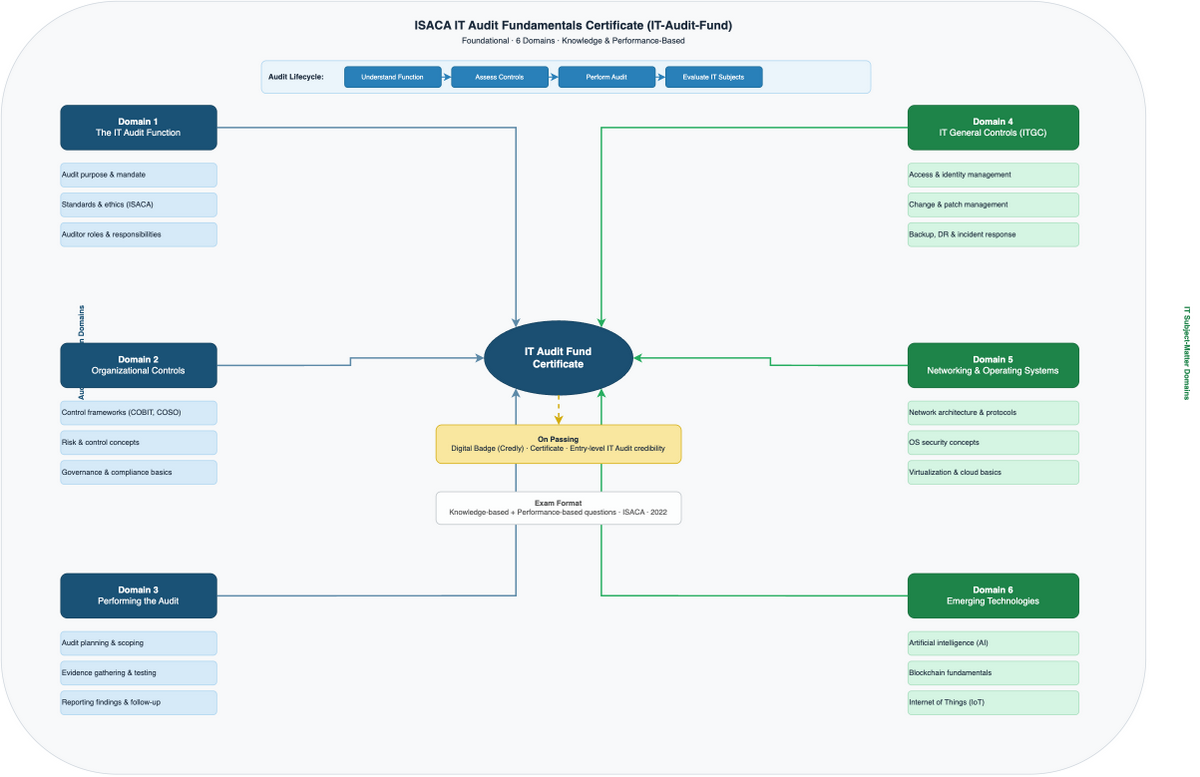
Exam at a glance
| Item | Value |
|---|---|
| Cost | $175 USD (members) / $225 USD (non-members) |
| Duration | 120 minutes |
| Questions | 55 |
| Passing Score | 65% (approximately 36 of 55 questions) |
| Format | Multiple choice and interactive (performance-based hybrid); computer-based |
| Validity | No expiry published |
| Testing | Online proctored (remote); continuous registration |
| Retake Policy | 30-day wait after 1st failed attempt; 90-day wait after 2nd and 3rd failed attempts; maximum 4 attempts within a rolling 12-month period |
Two things about the format deserve more than a table row.
First, "interactive" questions are not your standard four-option multiple choice. Performance-based items may ask you to match controls to risk scenarios, sequence audit steps, or drag-and-drop items into correct categories. The mechanics change how you study: passive reading won't prepare you for interactive question formats. You need to practice applying the concepts, not just recognizing them.
Second, 120 minutes for 55 questions gives you just over two minutes per question. That's comfortable on straightforward recall items, but scenario-based questions take longer to parse. Don't assume you'll have time to spare.
What this exam is really testing
ISACA built this certificate for two audiences: people launching careers in IT audit, and professionals from adjacent fields, finance, internal audit, compliance, risk, who need to add IT audit literacy without committing to a full CISA track.
The exam reflects that positioning. It tests conceptual layers, not technical commands. You won't be asked to write a firewall rule or configure an access control list. You will be asked to identify what an auditor should evaluate, why a specific control exists, and what risk scenario makes that control relevant.
Think of it as a governance-and-process mindset exam. The question it keeps asking, in different forms, is: "What does an IT auditor do here, and why?" Candidates who anchor every domain to that question navigate the exam more cleanly than those who treat each domain as a disconnected list of terms.
Who should take this exam
This certificate is the right credential if you're entering IT audit from scratch, pivoting from a financial or operational audit background, or working in a GRC role that touches IT without deep audit exposure. It's also a sensible first step for students in information systems, accounting, or cybersecurity programs who want an ISACA credential before they have the work experience for CISA.
It's probably not the right investment if you already hold CISA, CISM, or CRISC. Those credentials cover this material at greater depth. Experienced IT auditors with several years of hands-on work may find this exam covers ground they've long since internalized.
Domain breakdown
Domain 1, Performing an Audit (35%)35%
The heaviest domain on the exam is where you'll want to funnel most of your study time. At 35% of the total score, it carries real weight in determining whether you pass.
"Performing an audit" covers the full lifecycle: planning and scoping, evidence collection, testing procedures, documentation, and reporting. ISACA's framework structures audit work into defined phases, and the exam expects you to know what belongs in each phase and why the sequencing matters.
The domain is also where the exam's scenario orientation is sharpest. You won't just be asked to define "audit evidence", you'll be placed in a scenario where an auditor has collected certain evidence and asked what step logically follows, or what the auditor may have missed. Build your understanding of the audit process as a workflow, not a glossary.
Domain 2, IT Environment and Components (25%)25%
The second-largest domain tests your ability to understand the technology landscape an IT auditor operates in. Networks, operating systems, databases, applications, and cloud environments all appear here as things an auditor must understand at a conceptual level.
The word "components" in the domain name is accurate. You're not expected to administer these systems; you're expected to know what an auditor looks for when evaluating them. What controls protect a database? What does access management look like in a cloud environment? What makes a network architecture more or less auditable? Database operations and access controls surface repeatedly in practice questions, they're the core of how this domain shows up on exam day.
Candidates from pure audit backgrounds sometimes underestimate this domain. If your previous experience is in financial audit with minimal IT exposure, spend extra time here building the conceptual map.
Domain 3, Specific Audit Subjects (15%)15%
This domain shifts from the general audit process to particular subject areas that get dedicated audit attention. Application controls, change management, and IT project governance are representative areas, though official documentation doesn't publish an exhaustive topic list.
The key distinction to carry into this domain: a subject-specific audit still follows the same lifecycle as any other audit (Domain 1), but the scope and the controls being evaluated are shaped by the specific subject. An application controls audit asks different questions than a disaster recovery audit, but both still require planning, evidence, testing, and reporting.
Domain 4, Overview of Newer Technologies (12%)12%
At 12% this domain is unlikely to determine whether you pass or fail, but it's the area where official ISACA guidance is most explicit about specific topics. Official exam materials name AI, blockchain, and IoT as audit areas candidates should understand.
The exam tests audit relevance, not technical depth. For AI: what risks does AI introduce that auditors should evaluate? For blockchain: what makes it resistant to certain kinds of manipulation, and what audit challenges remain? For IoT: what expands the attack surface and how should auditors scope that risk?
You don't need to understand how to build a machine learning model. You need to understand what an auditor's questions would be when one is in use.
Domain 5, Controls, Risk and Audit (8%)8%
Don't let the low weight fool you. IT general controls (ITGCs) are foundational to everything else on this exam, and this domain is where they're addressed most directly.
ITGCs govern access to systems, change management processes, computer operations, and the IT infrastructure that financial reporting systems depend on. Understanding why ITGCs matter to an auditor, and what a deficiency in ITGCs means for an organization's broader risk posture, underpins the scenario logic throughout the whole exam.
At 8%, it's the second-smallest domain. But the concepts it covers surface in Domain 1 and Domain 3 questions constantly. Skipping it would be a mistake.
Domain 6, Audit Function (5%)5%
The smallest domain covers the organizational context of the internal audit function: its purpose, its independence requirements, its relationship to governance, and how it fits within a broader risk management structure.
Five percent is five percent. Don't ignore it, but don't overinvest. One focused session is enough for most candidates. The concepts here, audit charter, independence, reporting lines, are foundational governance ideas that should feel intuitive once you've engaged with the rest of the material.
Failure patterns
The exam has a 65% passing threshold, which sounds forgiving. Whether it actually is depends on how you prepared.
Treating it like a vocab exam. The interactive format punishes candidates who memorized definitions without understanding application. If you can define "IT general control" but can't place it in a scenario, you'll struggle with the performance-based questions.
Skimping on Domain 1. It's 35% of the exam. That's not a suggestion to study it harder; that's the exam's explicit weighting. Candidates who distribute their study time evenly across all six domains leave points on the table.
Neglecting the IT environment domain. Audit professionals without IT backgrounds often approach Domain 2 lightly. The domain is deliberately conceptual, but concepts you haven't encountered before still require study time.
Underestimating the newer technologies domain. Frankly, this is the domain that surprises people who didn't read the official material carefully. AI, blockchain, and IoT aren't bonus topics, they're explicitly called out in ISACA's own guidance. Candidates who assumed this domain would only show up in edge cases discover it appears more frequently than expected.
Running out of time on scenario questions. The two-minutes-per-question average masks variance. Allocate time deliberately and don't let a complex scenario question stall your progress through the rest of the paper.
Retake reality
ISACA has not published pass rates for the IT Audit Fundamentals Certificate, and given that this is a relatively new and niche credential, independent community data on first-attempt pass rates is essentially absent. There are no meaningful candidate report threads to draw from. What the structure of the exam does tell you: a 65% threshold is achievable for a prepared candidate, and the performance-based question format is the most likely differentiator between those who pass and those who need a second attempt. Prepare for interactive questions specifically. Everything else is execution.
If you do need to retake, the official candidate guide documents the waiting periods clearly: 30 days after a first failed attempt, then 90 days after each subsequent failed attempt, with a maximum of four attempts within any rolling 12-month period. Each attempt requires full payment of the exam fee, so passing on the first try matters financially as well as logistically.
How to prepare
The official self-paced course. ISACA offers its own eLearning course covering all six domains, with video content, interactive modules, downloadable resources, and performance-based labs. The course carries approximately 10 hours of seat time and earns 12 CPEs on completion. For a foundational credential with no experience prerequisite, this course is the natural starting point. Its primary limitation is the same as any self-paced course: it can make the material feel easier than the exam, because passive consumption doesn't replicate the decision-making pressure of scenario questions.
Practice questions. Do this. Specifically, start with practice questions at CertCompanion, work through realistic scenario questions with detailed explanations, and aim for consistent 80–90% scores before you schedule your exam date. The gap between what you know and what you can do under exam conditions is exactly what practice questions reveal. Start with the free questions on the platform before you commit to a full practice set.
You'll also find ISACA credential resources across the ISACA provider hub, which is worth bookmarking for when you're ready to move beyond this certificate.
Official exam tools to use:
- ISACA's official eLearning course (video, labs, interactive modules; all six domains)
- The official Certificate Program Exam Candidate Guide PDF (available on ISACA's site; read it before you book)
- ISACA's resources page for the certificate (study materials and supplementary content)
- The 12 CPEs earned on course completion (directly applicable to ongoing professional development)
ISACA membership discount. If you're not already a member, the $50 difference between member ($175) and non-member ($225) pricing is worth considering against the ISACA annual membership fee. If you plan to pursue CISA eventually, membership pays off at scale.
Study timeline
The official course runs approximately 10 hours. How much additional time you need depends on your background. The figures below are estimates based on the official course duration; independent community data on study time for this certificate is too sparse to cite.
| Background | Estimated hours | Notes |
|---|---|---|
| IT professionals with audit exposure | 10–15 hours | Official course plus targeted practice questions on weaker domains |
| IT professionals, no audit background | 15–25 hours | Additional time on audit methodology, ITGC concepts, and Domain 1 scenarios |
| Non-IT audit or finance background | 20–35 hours | Build the IT environment foundation first; the official course is necessary, not optional |
These ranges are estimates. The only reliable signal is your practice exam performance. If you're consistently clearing 85% across all six domains on practice questions, you're ready. If Domain 2 or Domain 1 is dragging your score down, address that before booking.
On exam day
You're taking this remotely. That means a clean, quiet room, no secondary monitors, and your ID ready before the session starts. These aren't suggestions from the candidate guide; they're enforced during the proctor check.
Time management for this specific format: read every question fully before selecting an answer. Interactive questions in particular can look simpler than they are on a first pass. The scenario context is load-bearing, changing how you understand the scenario often changes the correct answer.
For multiple choice questions with scenario framing, look for the answer that reflects what an auditor would do, not just what's technically correct in isolation. The exam is testing audit judgment, not IT trivia.
Scores for remote proctored exams often post quickly, sometimes same-day. ISACA will send notification to your registered email when results are available. Badge access follows after ISACA confirms the result.
What the cert actually does for you
The IT Audit Fundamentals Certificate is an entry credential. It signals audit literacy to employers and positions you for first-role IT audit opportunities. It gives you the ISACA brand behind your name before you've accumulated the work experience CISA requires.
The certificate doesn't close the CISA gap, but it opens the door to roles where you can begin accumulating the experience that will.
Roles that list IT audit credentials at the entry level include IT Auditor, IT Audit Analyst, GRC Analyst, and Information Security Auditor. The certificate is particularly useful for candidates pivoting from financial or operational audit roles who need a signal to hiring managers that they can operate in an IT context.
Renewal and CPEs. The certificate doesn't appear to carry a published expiry date based on official documentation, but ISACA professional development expectations apply if you're maintaining other ISACA credentials alongside it. The 12 CPEs earned from the official course can count toward those requirements.
Logical next certifications:
- CISA (Certified Information Systems Auditor): The primary career progression for IT auditors; requires five years of relevant work experience but is the standard for senior practitioners
- CISM (Certified Information Security Manager): Useful if your career path trends toward security management and risk governance
- CRISC (Certified in Risk and Information Systems Control): Strong fit for GRC roles where risk identification and controls management are the core function
FAQ
Is the IT Audit Fundamentals Certificate hard? For a foundational exam, it's appropriately challenging if you prepare correctly. The 65% passing threshold is relatively accessible, but the performance-based interactive questions require applied understanding, not just memorization. Candidates who treat it as a vocabulary test and skip scenario practice tend to be surprised on exam day.
How many study hours does this exam require? The official ISACA self-paced course runs approximately 10 hours of seat time. Most candidates will need additional time for practice questions and domain review, particularly those without prior IT or audit backgrounds. A realistic range is 10 to 35 hours total depending on starting knowledge, but independent community data on this exam is too limited to give a confident average.
Does the certificate expire? ISACA has not published an expiry date for this certificate in official documentation. Unlike CISA, which carries annual CPE and maintenance requirements, the certificate program appears to operate differently. Confirm current maintenance requirements directly with ISACA before making decisions based on this.
Do I need experience to take this exam? No. Official ISACA documentation explicitly states that no prior experience is required. The certificate was designed as an entry-point credential for career changers and students.
What's the retake policy? The official candidate guide documents the policy in full. Candidates have four attempts within a rolling 12-month period. After a first failed attempt, wait 30 days before rebooking. After a second or third failed attempt, the wait extends to 90 days. Each attempt requires full payment of the exam fee.
Is this certificate worth it for experienced IT auditors? Probably not as a standalone credential. If you already work in IT audit or hold CISA, CISM, or CRISC, the foundational material here is unlikely to add much to your profile. The certificate is positioned for candidates who are new to the field.
How is it different from CISA? CISA is a professional-level certification requiring five years of relevant work experience, covering audit methodology in substantially more depth, and carrying annual maintenance requirements. The IT Audit Fundamentals Certificate is a no-experience-required foundational entry point, arguably a preparation step toward CISA rather than a direct alternative.
What jobs list this certificate? Entry-level IT Auditor, IT Audit Analyst, GRC Analyst, and Information Security Auditor are the roles most commonly associated with this credential. It's primarily relevant for first-role positioning rather than mid-career advancement.
The IT Audit Fundamentals Certificate is a well-scoped entry exam. It won't take months to prepare for, won't drain your bank account, and won't require years of prior experience. What it requires is a genuine engagement with audit methodology as a process and a governance mindset, not just a collection of terms. Study Domain 1 seriously, build your IT environment conceptual map if it isn't already there, and practice with scenario questions before you book. Do that and 65% is realistic on the first attempt.
Start with free practice questions and work up to full timed sets at CertCompanion, the scenario-based format is the closest preparation available to the real exam.
Checked against official ISACA IT-Audit-Fund exam documentation and current candidate reports. Last verified 2026-10-13.