Most candidates study for the CCISO the same way they studied for the CISSP, and most of them walk out surprised. This exam doesn't reward technical depth. It rewards executive judgment: how you allocate budget, govern risk, manage vendors, and answer to the board. The five domains look familiar until you sit the exam and realize every question is asking what a CISO decides, not what a security engineer knows.
What do most people get wrong before they even start?
The CCISO is EC-Council's certification for working or aspiring CISOs. Exam code 712-50. One hundred and fifty multiple-choice questions in 150 minutes. Passing score varies by exam form, ranging from 60% to 85%, with 72% cited most often across community sources as the typical threshold. Cost: $999, retakes $499.
None of that is the thing most people get wrong.
What they get wrong is the mental model. The CCISO is not a knowledge-breadth exam in the CISSP mold. It's a judgment exam. The questions don't test whether you know what ISO 27001 is. They test whether you know when to invoke it, how to defend the decision to the CFO, and what happens when a vendor doesn't comply. If you approach this as a technical cert, the finance and procurement questions will cost you.
Quick facts before you go further
- Exam code: 712-50
- Cost: $999 USD (retake: $499)
- Duration: 150 minutes, 150 questions, about one minute per question
- Passing score: Varies by exam form (60%–85%); 72% is the most commonly cited threshold
- Format: Multiple choice, covering knowledge, application, and analysis cognitive levels
- Validity: 3 years; renewal requires 120 CPE credits plus a $100 annual EC-Council membership fee (paid each year of the cycle, not once)
- Testing: Authorized testing centers (online proctored at authorized sites)
- Retakes: Up to 5 retakes within one year
- Community prep time: 6–12 weeks of dedicated study, depending heavily on background
- The one thing: This exam is not technical. Budget for Domain 5 early, not as an afterthought.
So what is this exam actually testing?
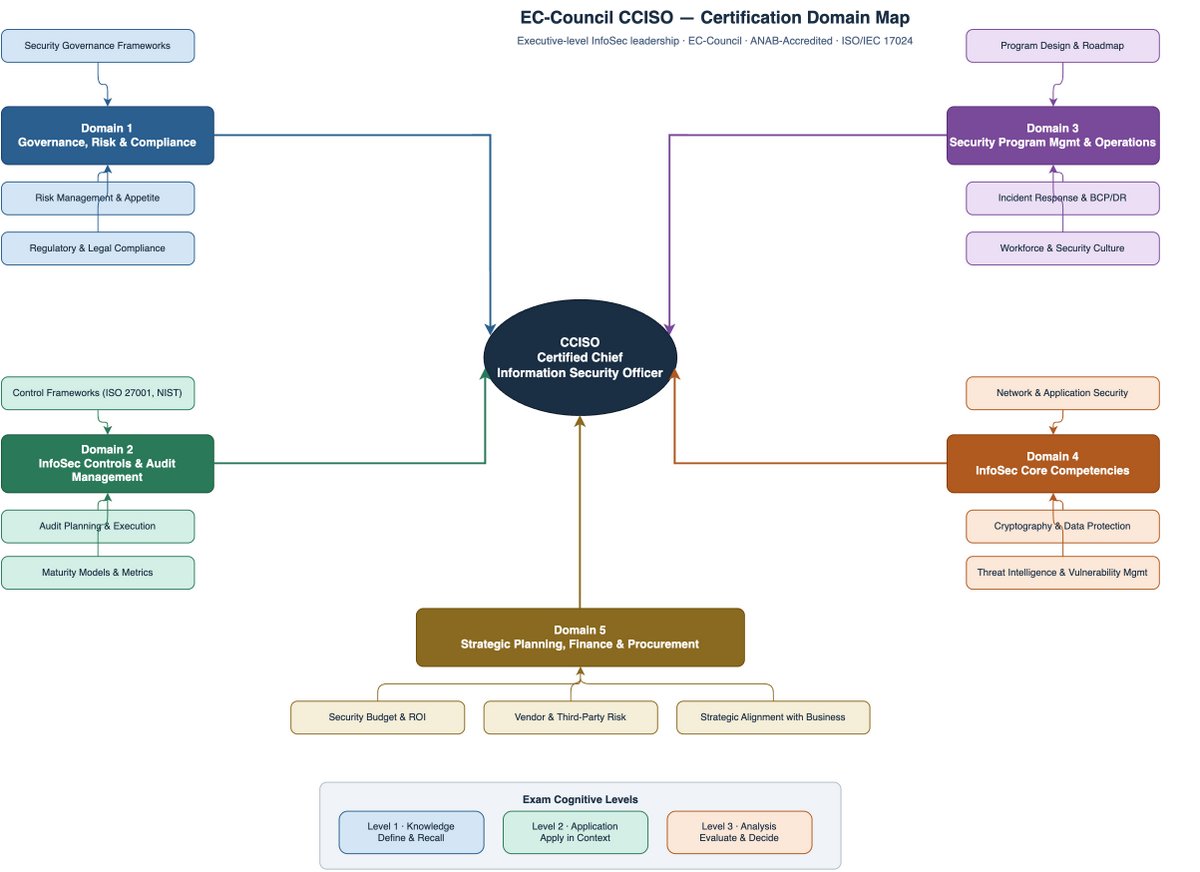
EC-Council built the CCISO to validate people who run security programs, not people who configure them. The five domains cover governance, controls and compliance, program operations, security core competencies, and strategic finance. But the through-line across all five is the same: can you make the call that a CISO has to make, given organizational objectives, regulatory exposure, and budget constraints?
The questions operate at three cognitive levels: knowledge (recall), application (applying a concept to a scenario), and analysis (reasoning through competing options). In practice, most of the harder questions are analysis-level. You'll see scenarios where two answers look defensible and the differentiator is business context. A technically correct control might be wrong when the organization's risk appetite or strategic direction makes another choice more appropriate.
Candidates who've written up their experience consistently flag the same thing: the exam "is not very technical in nature." That's a warning, not a comfort. It means the preparation that got you through your last hands-on cert won't be sufficient here. Understanding why a CISO makes a particular governance decision requires a different kind of study than understanding how a protocol works.
What changed in the latest version?
The current official exam blueprint is v2, available as a PDF from the EC-Council CCISO exam information page, confirmed live as of a September 2026 check. Don't confuse this with the "CCISO Version 3" label EC-Council uses on some courseware and exam-voucher bundles in its store, that version number describes the training materials, not the exam blueprint. Until EC-Council officially updates the exam blueprint itself, study from v2.
The practical implication: the domain structure and weightings in this post reflect v2. If you're reading this after a version change is confirmed, pull the new blueprint before you finalize your study plan. The blueprint is the syllabus. Candidates who neglect it and study from memory of past exams often find their coverage has gaps.
Who should take this exam, and who should wait?
The CCISO is designed for candidates with demonstrated leadership experience in information security. EC-Council requires five years of experience across at least three of the five CCISO domains (experience requirements overlap in day-to-day security management roles, so most working senior security professionals will qualify, but verify directly with EC-Council, since sources conflict on the exact structure).
The right candidate for this exam:
- Is currently in or pursuing a CISO, Director of Security, or senior security program management role
- Has budget authority or significant input into security program investment decisions
- Needs a credential that speaks to boards, auditors, and executive leadership rather than technical peers
- Wants to signal C-suite readiness in regulated industries (financial services, healthcare, government)
The candidate who should wait: someone primarily in a technical or engineering role who hasn't yet had exposure to security program budgeting, vendor governance, or executive reporting. The finance and procurement domain alone will be a significant lift. Better to accumulate that experience first than to pass through sheer memorization and not retain anything useful.
If you don't yet meet the experience requirements, EC-Council offers an Associate CCISO pathway and an EC-Council Information Security Manager (EISM) program as a pre-qualification route.
The five domains, what's actually in each one?
Domain 1, Governance and Risk Management (16%)16%
This domain covers the design and operation of an information security governance program. The topics include defining leadership and organizational structures, aligning security frameworks to organizational goals, and building monitoring frameworks that report meaningful risk information upward.
The risk management portion is more granular than candidates expect. You need to understand policy charters, risk assessment methodologies, risk registers, and how to design a reporting cadence that senior leadership can act on. Cost/benefit analysis and compliance program management round out the domain.
Community sources describe this as one of the backbone domains, something you need to study with real depth, not just familiarity. Questions test governance decision-making from the CISO's chair. Knowing that a risk register exists is not the same as knowing how to structure one for a $2 billion financial institution. Study the governance frameworks with enough depth to apply them to scenarios.
Domain 2, Information Security Controls, Compliance and Audit Management (18%)18%
The highest-weighted domain alongside Domain 3. It covers control design, testing control effectiveness before implementation, remediating deficiencies, and automating control processes where appropriate.
The compliance component requires understanding of the ISO 27000 and 31000 series, not just knowing these frameworks exist, but understanding what they require and how to operationalize them. Managing enterprise compliance programs, conducting audits, and reporting compliance status to leadership are all in scope.
The audit management section draws on ISACA principles. Risk-based audit strategies, evaluating audit results, and building audit documentation processes are tested. Some candidates with limited audit backgrounds find this section requires building up new mental models rather than reinforcing existing ones. Limited community data suggests this is considered a complex area, allow extra time if your background is primarily operational security rather than compliance or audit.
Domain 3, Security Program Management & Operations (22%)22%
At 22%, this is one of the two heaviest domains by weight. It covers the operational mechanics of running a security program: scope definition, budget development, resource acquisition, team development, communications protocols, and personnel issue resolution.
The vendor management component lives here too, managing vendor agreements, assessing proposed solutions for compatibility, and evaluating project management practices. This isn't vendor management in the procurement sense (that comes in Domain 5). Here it's about managing relationships and outcomes once contracts are in place.
Budget and program management aspects present a genuine challenge for candidates with purely technical backgrounds, according to community sources. The questions aren't asking you to build a spreadsheet, they're asking you to make the call a CISO makes when a project is over budget, under-resourced, or delivering less than promised.
Domain 4, Information Security Core Competencies (25%)25%
The highest-weighted domain on the exam. It spans nine sub-areas covering the full security stack:
- Access control (mandatory and discretionary models, physical credentials, biometrics)
- Security awareness and social engineering countermeasures
- Insider threat mitigation
- Physical security
- Network security
- Application security
- Data protection and encryption
- Cloud security
- Emerging and transformative technologies
The breadth is what makes this domain challenging. None of these areas is tested to the depth of a specialist certification, but all of them require executive-level fluency. The trap is assuming this domain is easy because the topics are familiar. The questions ask how a CISO prioritizes and governs across these areas, not how to configure them.
Some candidates report this as a difficulty area alongside Domain 5, given the sheer breadth of topics. The community data on this is limited, but the pattern is consistent: don't skip the coverage review assuming you already know it. The framing is what's different.
Domain 5, Strategic Planning, Finance, Procurement, and Third-Party Management (19%)19%
This is the domain that catches technically-focused candidates off guard. Every practitioner experience thread says the same thing: the finance and procurement depth surprises people who've spent their careers on the technical side of security.
The topics include full lifecycle budgeting, ROI analysis, business case development, reading balance sheets and income statements, understanding depreciation and amortization, supplier governance, and vendor-risk lifecycle management. If you've never built a security budget or presented a business case to a CFO, this domain requires actual learning, not review.
The top advice from multiple experience reports: build a sample budget, a business case, and a vendor-risk lifecycle as part of your study process. Working through these exercises develops the decision-making instincts the exam questions require. Reading about ROI is not the same as understanding how to frame a security investment in terms that earn executive approval.
Frankly, this is the domain that separates the CCISO from every other security certification. If you treat it as a minor topic to skim through, the exam will make you aware of that mistake.
Where do candidates lose points?
The failure patterns are consistent across every experience report worth reading:
Underweighting Domain 5. Technical candidates assume their strengths in Domains 1 and 4 will carry them. They study governance and security competencies thoroughly and breeze past the finance and procurement domain. Then they hit eight to ten questions on depreciation, ROI frameworks, and vendor contract structures and lose points they can't recover.
Treating this like a knowledge exam. The CCISO tests application and analysis, not recall. Memorizing domain definitions doesn't prepare you for a scenario where the right answer depends on the organization's risk appetite and strategic objectives. The pattern across pass reports shows that candidates who studied "why" decisions get made outperformed those who studied "what" the correct answer is.
Skipping timed practice. One hundred and fifty questions in 150 minutes is exactly one minute per question. That's achievable, if you've practiced it. Candidates who haven't done full-length 150-question timed practice exams before test day report running out of time or rushing through the back half. There's no buffer built into this format.
Ignoring the blueprint. The exam blueprint (v2) lists exactly what's in scope. Candidates who study from memory of other certifications or from outdated resources find gaps in their coverage. Pull the blueprint early and use it as your checklist.
Using exam dumps. Beyond violating EC-Council's terms and conditions, dumps fail to prepare you for analysis-level questions. The scenarios change. The underlying judgment doesn't.
Watch out for questions that present a technically correct answer alongside the strategically correct answer. The exam is testing executive judgment, which means "the right thing from a security engineering perspective" and "the right thing from a CISO perspective" are sometimes different options.
How should you actually prepare?
Start with the official EC-Council CCISO Body of Knowledge. This is the primary study material and it's comprehensive. EC-Council's CCISO program page provides access through training packages. The CBK covers all five domains and is the authoritative source for what's in scope.
Official training options give you structure and, in some cases, an exam voucher:
- EC-Council's CCISO iLearn on-demand package offers approximately 40 hours of recorded video content, self-paced. One passing candidate completed their 2.5-month prep using this as the primary resource.
- EC-Council's 5-day instructor-led course, available in-person or live online, follows the same official courseware and may include an exam voucher.
The official content is thorough but, like most vendor-produced training, it's easier than the actual exam. Don't mistake completing the course for being ready.
Practice questions are non-negotiable. Use CertCompanion's CCISO practice exams at /exams/ec-council-cciso as your primary practice resource. The goal before you schedule the real exam is 80–90% on full-length practice tests. Start with domain-specific sets to identify weak areas, then move to full 150-question timed mocks. If you're scoring below 80% on practice exams, you're not ready yet.
Official EC-Council training materials and CertCompanion practice exams provide comprehensive coverage across all five domains. The combination of the official CBK and realistic scenario-based practice questions is the preparation path that holds up.
Additional official resources:
- EC-Council CCISO Blueprint v2 (PDF from the official exam information page), treat this as your study checklist
- CISO Library on the EC-Council CCISO site: whitepapers, webinars, and podcasts that build executive context
- Official practice questions included with EC-Council on-demand training packages
On frameworks: The exam references roughly 20 ISO standards and the NIST SP 800 series. You don't need to memorize every control in every standard, but you need to understand what each framework governs, when you'd apply it, and what a CISO does with it. NIST Cybersecurity Framework, ISO 27001, ISO 31000, and relevant privacy regulations are the core set.
Schedule your exam date early. Candidates who pick a target date before they feel ready study with more urgency. The 30/60/90-day timeline structure works well: 30 days for foundational coverage, 60 days for domain-specific deep dives and first practice exams, 90 days for full-length timed mocks and weak-area remediation.
How long does preparation take?
The community data here has limited sourcing, so treat these as rough ranges rather than guarantees:
| Background | Estimated time | What drives the difference |
|---|---|---|
| Seasoned security executive (budget experience, C-suite exposure) | Approximately 6 weeks | Governance and program management are familiar; Domain 5 still needs attention |
| Senior security professional without finance exposure | 6–8 weeks at roughly 10–15 hours per week | Domain 5 requires genuine learning; timed practice takes time to build up |
| Mid-career security professional building toward executive roles | 12+ weeks | More foundational work needed on governance, finance, and compliance frameworks; material is also harder to find than for certs like CISSP |
The honest note on study materials: limited resources are available for the CCISO compared to certs like CISSP or CISM. This is a real constraint. Budget extra time if you can't find quality practice questions that match the format.
What should you do on exam day?
This is a pacing exam. At one minute per question, you have no margin for getting stuck on hard scenarios. The community reports that have held up consistently:
Answer easier questions first. Flag the ones that require extended reasoning and return to them. Spending four minutes on a single question early in the exam is how you run out of time at question 140.
Use process of elimination deliberately. Most scenarios have one or two clearly wrong answers. Eliminating them improves your odds even when you're uncertain about the best remaining choice.
The exam results display immediately after completion. Your certificate arrives within 7–10 days of passing.
One practical note: if you're taking this at an authorized testing center, confirm the location and check-in requirements well in advance. The CCISO isn't offered at every testing location, and last-minute rescheduling on a $999 exam is a frustration worth avoiding.
After you pass: what does the CCISO actually do for you?
The CCISO is a C-suite credential. The roles that list it or give it weight: Chief Information Security Officer, Director of Security, Senior IT Security Manager, Security Consultant, and Program Manager (Information Security) at enterprise organizations.
According to Glassdoor and Salary.com data, CISO total compensation for most US companies ranges from $250,000 to $700,000. Public-company CISOs frequently exceed $1,000,000. Fractional CISO arrangements typically start around $180,000. The variation by industry is meaningful: Technology and SaaS leads at $350,000–$700,000 and above, Financial Services follows at $300,000–$550,000 and above, Healthcare ranges from $250,000 to $400,000, and Retail and Manufacturing from $220,000 to $350,000. Board fluency and regulated-industry experience command premium compensation.
One comparative source puts CCISO-certified professionals in the $100,000–$200,000 range, which appears to reflect smaller organizations or professionals earlier in the CISO career path rather than enterprise-level roles.
Renewal: 120 CPE credits over the three-year validity cycle, plus EC-Council's Continuing Education membership fee, $100 per year for CCISO specifically (most other EC-Council certs pay $80 per year), so budget roughly $300 across the full cycle, not a single $100 charge.
Logical next certifications (based on what experienced professionals pursue):
- CISSP (ISC2): Complements the CCISO with deeper technical and operational security knowledge. Many CISOs hold both.
- CISM (ISACA): Management-focused, overlaps significantly with CCISO governance domains. Worth considering if your organization uses ISACA frameworks.
- CCSP (ISC2): Extends your credential coverage into cloud security governance.
- EISM (EC-Council): The pathway for professionals who aren't yet eligible for full CCISO certification.
FAQ
How hard is the CCISO exam compared to CISSP? Different kinds of hard. The CISSP is broad and technically demanding across eight domains. The CCISO is narrower in scope but tests at a different cognitive level: executive judgment rather than security engineering knowledge. Candidates with CISSP often find the technical domains comfortable and are surprised by the finance and strategic planning content. The CCISO is arguably harder for technical specialists and more accessible for people who've actually managed security programs and budgets.
How many hours of study does the CCISO require? Community data suggests a range of 6 to 12 weeks depending on background. Candidates closer to the CISO role in their current work tend toward the lower end. Those building from a primarily technical background and without finance exposure typically need closer to 12 weeks, and limited study materials for this cert (compared to CISSP) make that time harder to fill efficiently.
Does the CCISO expire? Yes. The CCISO certification is valid for 3 years. Renewal requires 120 CPE credits over the three-year cycle plus EC-Council's Continuing Education membership fee, which is $100 per year for CCISO (higher than the $80 per year most other EC-Council certs pay), so plan for roughly $300 total across the cycle. If you let it lapse, you'll need to retest.
Do I need to take a formal training course to sit the exam? EC-Council has required formal training in the past, but the current pathway should be verified directly on the CCISO program page, as policies can change. Check the official experience and training requirements before registering, this is one area where community sources conflict and the official source is authoritative.
What score do I need to pass? The official EC-Council position is that the cut score varies by exam form, ranging from 60% to 85%. The figure cited most consistently across multiple community sources is 72% (108 out of 150 questions correct). Aim for 80%+ on your practice exams so you have margin regardless of which form you receive.
Can I retake if I fail? EC-Council allows up to 5 retakes within one year of your original exam date. The retake fee is $499.
Is the CCISO worth pursuing if I already have a CISSP? If your career trajectory is toward executive leadership rather than technical architecture, the CCISO meaningfully differentiates you. The CISSP signals deep technical credibility. The CCISO signals readiness to run the security function at the organizational level: budget, governance, board reporting, and strategic risk management. Many working CISOs hold both. If you're aiming at a technical architect or senior practitioner role, the CCISO is probably not the right next step.
What's the biggest mistake candidates make in preparation? Treating Domain 5 as a minor section to get through quickly. The finance, procurement, and vendor management content is where technically-oriented candidates most consistently leave points on the table. Build a sample budget. Work through a business case. Understand what a balance sheet is telling a CISO. Then practice it under timed conditions.
The CCISO is a demanding exam for the right reasons. It tests a combination of governance knowledge, operational judgment, and financial fluency that genuinely reflects what senior security leadership requires. That combination is also what makes it hard to over-prepare for: there's no shortcut to developing executive thinking about security programs.
If you know the material, practice under realistic conditions, and give Domain 5 the attention it deserves, you're well positioned to pass. Start with the official Body of Knowledge, use full-length timed practice exams to identify gaps, and don't schedule the real exam until you're consistently hitting 80% or better.
Begin your CCISO preparation with realistic practice questions and detailed explanations at CertCompanion's CCISO exam page, start with 30 free questions and build from there.